


Space › Universe › Solar System › Star › Sun › Planet › Mars
Mars
ORBITS:
Sun
PLANET
Rust-red deserts. Traces of a wetter past.
Discover the red planet whose landscapes preserve signs of ancient water, then explore its place in the Solar System on the SPACE-di interactive map.
naif:
499
Reference material: NASA / Jet Propulsion Laboratory · NASA · 3D render credits
Make Mars part of your exploration…
A world shaped by change…
Mars is a planet in the Solar System, our region of space within the universe. The Sun is the star at the centre of this system. Explore its story and place in our planetary neighbourhood, then find it on the interactive 3D space map.
Mars preserves evidence of a wetter ancient environment, including dried river channels, lake basins and minerals formed in water. It is one of the most extensively explored worlds beyond Earth.
Interior: iron (Fe), nickel (Ni) and sulfur (S) in the core. Crustal elements include iron, magnesium, aluminium, calcium and potassium. Surface iron oxides give the red colour. Atmosphere: mostly carbon dioxide (CO₂), with nitrogen (N₂) and argon (Ar).
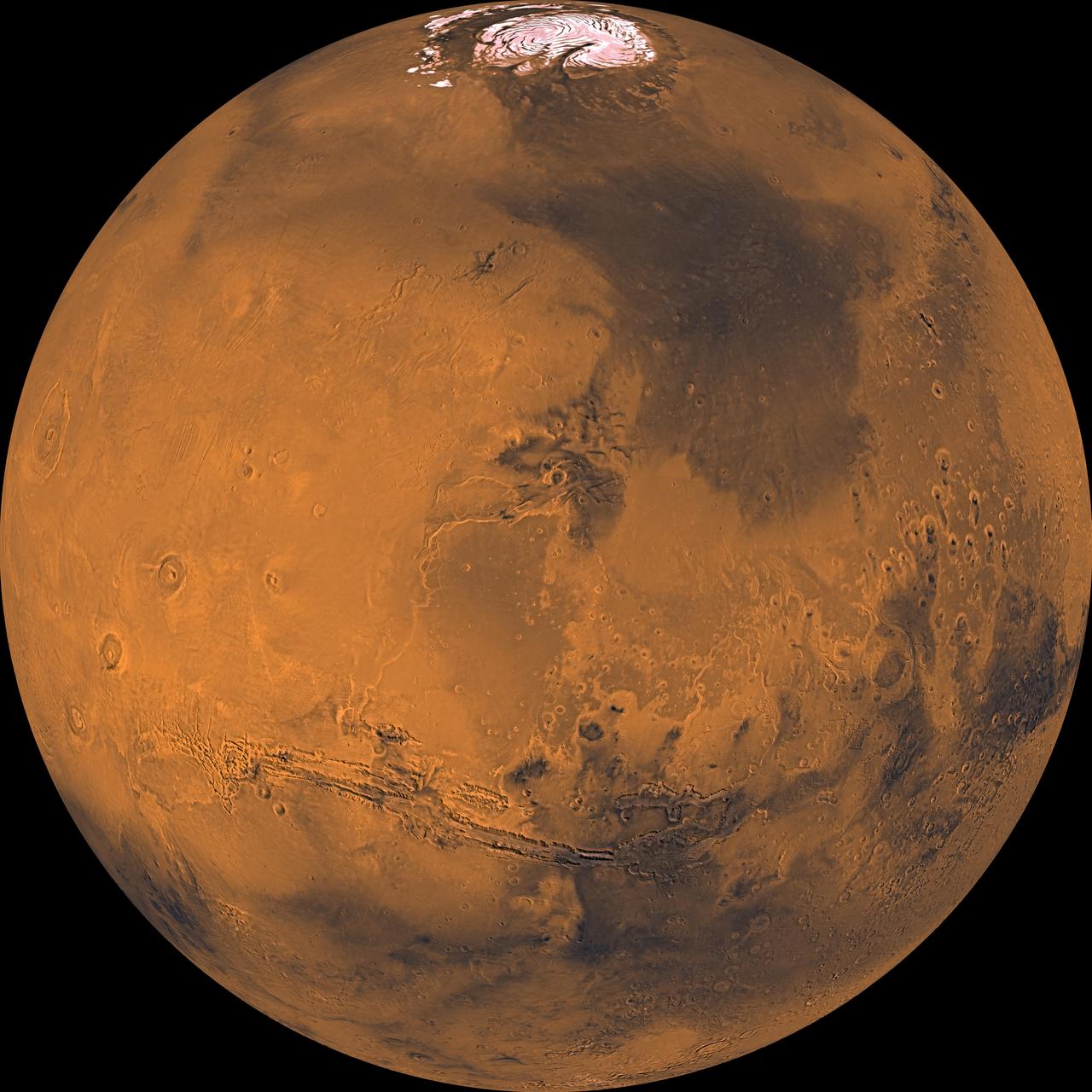
Mars — the fourth planet from the Sun — is a dusty, cold, desert world with a very thin atmosphere. This dynamic planet has seasons, polar ice caps, extinct volcanoes, canyons, and weather.
Mars is one of the most explored bodies in our solar system, and it's the only planet where we've sent rovers to roam the alien landscape. NASA missions have found lots of evidence that Mars was much wetter and warmer, with a thicker atmosphere, billions of years ago.
Mars was named by the ancient Romans for their god of war because its reddish color was reminiscent of blood. Other civilizations also named the planet for this attribute — for example, the Egyptians called it "Her Desher," meaning "the red one." Even today, it is frequently called the "Red Planet" because iron minerals in the Martian dirt oxidize, or rust, causing the surface to look red.
Scientists don't expect to find living things currently thriving on Mars. Instead, they're looking for signs of life that existed long ago, when Mars was warmer and covered with water.
With a radius of 2,106 miles (3,390 kilometers), Mars is about half the size of Earth. If Earth were the size of a nickel, Mars would be about as big as a raspberry.
From an average distance of 142 million miles (228 million kilometers), Mars is 1.5 astronomical units away from the Sun. One astronomical unit (abbreviated as AU), is the distance from the Sun to Earth. From this distance, it takes sunlight 13 minutes to travel from the Sun to Mars.
As Mars orbits the Sun, it completes one rotation every 24.6 hours, which is very similar to one day on Earth (23.9 hours). Martian days are called sols — short for "solar day." A year on Mars lasts 669.6 sols, which is the same as 687 Earth days.
Spring in the northern hemisphere (autumn in the southern) is the longest season at 194 sols. Autumn in the northern hemisphere (spring in the southern) is the shortest at 142 days. Northern winter/southern summer is 154 sols, and northern summer/southern winter is 178 sols.
Mars has two small moons, Phobos and Deimos, that may be captured asteroids. They're potato-shaped because they have too little mass for gravity to make them spherical.
The moons get their names from the horses that pulled the chariot of the Greek god of war, Ares (whose Roman counterpart is Mars).
Phobos, the innermost and larger moon, is heavily cratered, with deep grooves on its surface. It is slowly moving towards Mars and will crash into the planet or break apart in about 50 million years.
Deimos is about half as big as Phobos and orbits two and a half times farther away from Mars. Oddly-shaped Deimos is covered in loose dirt that often fills the craters on its surface, making it appear smoother than pockmarked Phobos.
Mars has no rings. However, in 50 million years when Phobos crashes into Mars or breaks apart, it could create a dusty ring around the Red Planet.
When the solar system settled into its current layout about 4.5 billion years ago, Mars formed when gravity pulled swirling gas and dust in to become the fourth planet from the Sun. Mars is about half the size of Earth, and like its fellow terrestrial planets, it has a central core, a rocky mantle, and a solid crust.
Mars has a dense core at its center between 930 and 1,300 miles (1,500 to 2,100 kilometers) in radius. It's made of iron, nickel, and sulfur. Surrounding the core is a rocky mantle between 770 and 1,170 miles (1,240 to 1,880 kilometers) thick, and above that, a crust made of iron, magnesium, aluminum, calcium, and potassium. This crust is between 6 and 30 miles (10 to 50 kilometers) deep.
The Red Planet is actually many colors. At the surface, we see colors such as brown, gold, and tan. The reason Mars looks reddish is due to oxidization — or rusting — of iron in the rocks, regolith (Martian “soil”), and dust of Mars. This dust gets kicked up into the atmosphere and from a distance makes the planet appear mostly red.
Interestingly, while Mars is about half the diameter of Earth, its surface has nearly the same area as Earth’s dry land. Its volcanoes, impact craters, crustal movement, and atmospheric conditions such as dust storms have altered the landscape of Mars over many years, creating some of the solar system's most interesting topographical features.
A vast canyon system called Valles Marineris is long enough to stretch from California to New York. This Martian canyon, the largest in the solar system, extends about 2,400 miles (3,870 kilometers) in length, spans about 370 miles (600 kilometers) across at its widest, and descends about 5.8 miles (9.3 kilometers) at its deepest, from the rim to the canyon floor. That's more than 10 times longer and wider than Earth's Grand Canyon.
Mars is home to the largest volcano in the solar system, Olympus Mons. It dwarfs Earth's highest peak, Mount Everest, which rises 29,029 feet, or 8,848 meters, above the Earth's surface. Olympus Mons stands more than 25 miles (that's more than 132,000 feet, or 40 kilometers) tall from base to summit, with the base covering an area as large as the state of Arizona.
Mars appears to have had a watery past, with ancient river valley networks, deltas, and lakebeds, as well as rocks and minerals on the surface that could only have formed in liquid water. Some features suggest that Mars experienced huge floods about 3.5 billion years ago.
There is water on Mars today, but the Martian atmosphere is too thin for liquid water to exist for long on the surface. Today, water on Mars is found in the form of water-ice just under the surface in the polar regions as well as in briny (salty) water, which seasonally flows down some hillsides and crater walls.
Mars has a thin atmosphere made up mostly of carbon dioxide, nitrogen, and argon gases. To our eyes, the sky would be hazy and red because of suspended dust instead of the familiar blue tint we see on Earth. Mars' sparse atmosphere doesn't offer much protection from impacts by such objects as meteorites, asteroids, and comets.
The temperature on Mars can be as high as 70 degrees Fahrenheit (20 degrees Celsius) or as low as about -225 degrees Fahrenheit (-153 degrees Celsius). And because the atmosphere is so thin, heat from the Sun easily escapes this planet. If you were to stand on the surface of Mars on the equator at noon, it would feel like spring at your feet (75 degrees Fahrenheit or 24 degrees Celsius) and winter at your head (32 degrees Fahrenheit or 0 degrees Celsius).
Occasionally, winds on Mars are strong enough to create dust storms that cover much of the planet. After such storms, it can be months before all of the dust settles.
Mars has no global magnetic field today, but areas of the Martian crust in the southern hemisphere are highly magnetized, indicating traces of a magnetic field from 4 billion years ago.
NASA Launches Twin Satellites to Investigate Mars' Space Weather
NASA's Escape and Plasma Acceleration and Dynamics Explorers (ESCAPADE) mission, which launched Nov. 13, will study Mars' real-time response to the solar wind, helping us better understand Mars' climate history — from a planet that hosted rivers, lakes, and floods billions of years ago, to the cold, dry desert we see on the surface today. The twin, refrigerator-sized orbiters are scheduled to arrive at Mars in September 2027, and begin their science mission the following spring.
Mars Exploration: Science Goals
The key to understanding the past, present or future potential for life on Mars can be found in NASA’s four…
NASA’s Mars Perseverance rover seeks signs of ancient life and collects samples of rock and regolith for possible Earth return.
Mars Science Laboratory: Curiosity Rover
Part of NASA's Mars Science Laboratory mission, at the time of launch, Curiosity was the largest and most capable rover…
Mars is the only planet we know of inhabited entirely by robots. Learn more about the Mars Missions.