


Space › Universe › Solar System › Star › Sun › Planet › Mars › Moon › Deimos
Deimos
ORBITS:
Mars
MOON
A quieter companion beyond Phobos.
Discover the smaller Martian moon on its more distant orbit, then explore its place in the Solar System on the SPACE-di interactive map.
naif:
402
Reference material: NASA / Jet Propulsion Laboratory · NASA · 3D render credits
Make Deimos part of your exploration…
Deimos: a companion of Mars…
Deimos is a moon of Mars, part of the Solar System in the universe. Mars is a planet associated with the Sun, our star, and this space encyclopedia describes the moon’s identity and place in its planetary system.
Deimos — A natural satellite of Mars. Its physical properties and orbital motion are shown from the available catalogue and ephemeris data.
No object-specific chemical/elemental dataset has been verified and imported for this record. This does not mean none is publicly available. Appearance may be imagined; chemistry is not.
Discovery and designation
Deimos was discovered in 1877. JPL credits A. Hall. The name and discovery entry identify this particular satellite of Mars; similarly named asteroids are separate objects.
Deimos is the smaller of Mars' two moons. It's 9 by 7 by 6.8 miles in size (15 by 12 by 11 kilometers). Deimos orbits Mars every 30 hours.
Deimos is the smaller of the two Martian moons and is less irregular in shape.
The largest crater on Deimos is approximately 1.4 miles (2.3 km) in diameter, 1/5 the size of the largest crater on Phobos.
Although both moons are heavily cratered, Deimos has a smoother appearance caused by the partial filling of some of its craters.
Like Phobos, Deimos is a small and lumpy, heavily cratered object. Its craters are generally smaller than 1.6 miles (2.5 kilometers) in diameter, however, and it lacks the grooves and ridges seen on Phobos. When impacted, dust and debris will leave the surface of the moon because it doesn't have enough gravitational pull to retain the ejecta. However, the gravity from Mars will keep a ring of this debris around the planet in approximately the same region that the moon orbits. As the moon revolves, the debris is redeposited as a dusty layer on its surface.
Deimos has a thick regolith, perhaps as deep as 328 feet (100 meters), formed as meteorites pulverized the surface.
Deimos is a dark body that appears to be composed of C-type surface materials, similar to that of asteroids found in the outer asteroid belt.
Deimos was discovered on Aug. 11, 1877 by Asaph Hall. Hall named Mars' moons for the mythological sons of Ares, the Greek counterpart of the Roman god, Mars. Deimos, whose name means dread, is the brother of Phobos.
NASA’s Perseverance Rover Watches Earth Vanish Behind Martian Moon
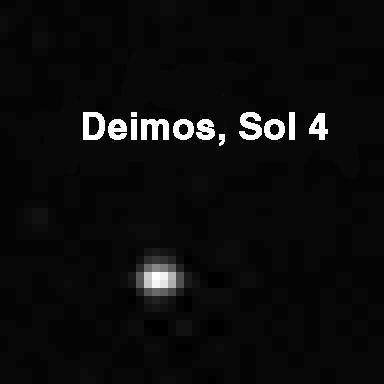
Perseverance Views Deimos Before Sunrise
Making Mars’ Moons: Supercomputers Offer ‘Disruptive’ New Explanation
Perseverance Captures Transit of Phobos
Mars is the fourth planet from the Sun, and the seventh largest. It’s the only planet we know of inhabited…
Mars is one of the most explored bodies in our solar system, and it's the only planet where we've sent…
Mars has two moons, Phobos and Deimos. Both are thought to be captured asteroids, or debris from early in the…
Phobos is the larger of Mars' two moons. It orbits Mars three times a day, and is so close to…