


Space › Universe › Solar System › Star › Sun › Planet › Mars › Spacecraft › Mars Odyssey
Mars Odyssey
ORBITS:
Mars
SPACECRAFT
Reading the chemistry of the Martian surface.
Discover the orbiter built to study Martian composition and relay surface-mission communications, then explore its mission on the SPACE-di interactive map.
naif:
-53
Reference material: NASA · NASA / Jet Propulsion Laboratory · 3D render credits
Make Mars Odyssey part of your exploration…
Mars Odyssey: a mission of discovery…
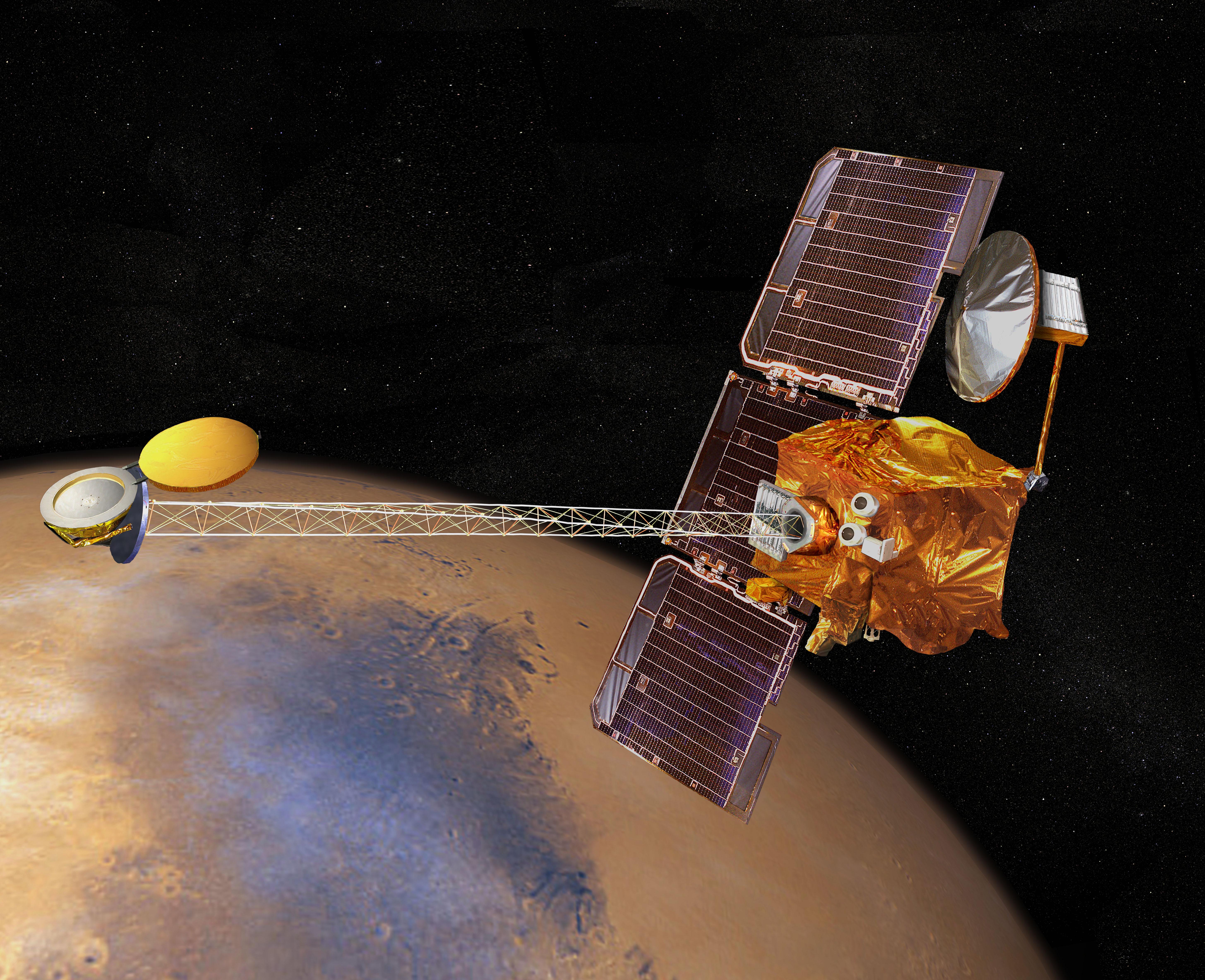
Mars Odyssey is a man-made spacecraft represented in the Solar System, the region of space around the Sun, our star, within the universe. Its catalogue reference body is Mars. Explore its story and purpose, then find the spacecraft on the interactive 3D space map.
Mars Odyssey — Studies Martian surface composition and relays communications for surface missions.
Mission and scientific objectives
Mars Odyssey is associated with NASA. Studies Martian surface composition and relays communications for surface missions. The mission type is Mars orbiter.
NASA’s 2001 Mars Odyssey mission created the first global map of chemical elements and minerals that make up the Martian surface.
Mars Odyssey mission was the first spacecraft to make a global map of the chemical elements and minerals that make up the Martian surface. The spacecraft also holds the record for the longest continually active mission in orbit around a planet other than Earth. It successfully completed its primary science mission from February 2002 through August 2004. Odyssey continues its work today, studying clouds, fog, and frost, and mapping surface rocks to make future Mars landings safer, as the orbiter continues to add to its 100,000+ orbits around the Red Planet.
No mission has been active at Mars longer than 2001 Mars Odyssey, which launched on April 7, 2001, and arrived at the Red Planet on Oct. 24, 2001.
What Would Mars Look Like for an Astronaut in Orbit?
NASA's Mars Odyssey orbiter, which will mark 25 years in orbit in 2026, during which it's made more than 100,000 trips around the Red Planet, captured the first-ever views of Mars that showcase the curving horizon and layers of atmosphere. Taken from an altitude of about 250 miles (400 kilometers), the same altitude at which the International Space Station flies above Earth, the views of Mars are similar to what an astronaut on board the ISS sees of Earth. While there are no astronauts yet at Mars, this view gives us a sense of what they might see, including gauzy layers of clouds and dust.
Mars Relay Network — 'The Interplanetary Internet'
The Mars Odyssey orbiter's telecommunications systems provide a crucial service for Martian spacecraft, serving as the first link in a communications bridge back to Earth — an "interplanetary Internet" that can be used by numerous international spacecraft in coming years.
2001 Mars Odyssey has contributed numerous science results supporting the Mars Exploration Program’s overall strategy – “Follow the Water.”
Odyssey Team Celebrates on a Global Map of Mars
THEMIS Views Mars’ Arsia Mons Volcano
NASA Mars Orbiter Captures Volcano Peeking Above Morning Cloud Tops
What NASA Is Learning from the Biggest Geomagnetic Storm in 20 Years
Mars Science Laboratory: Curiosity Rover
Part of NASA's Mars Science Laboratory mission, at the time of launch, Curiosity was the largest and most capable rover…
NASA’s Mars Perseverance rover seeks signs of ancient life and collects samples of rock and regolith for possible Earth return.
Mars Exploration: Science Goals
The key to understanding the past, present or future potential for life on Mars can be found in NASA’s four…
Mars is the fourth planet from the Sun, and the seventh largest. It’s the only planet we know of inhabited…