


Space › Universe › Solar System › Star › Sun › Planet › Mars › Spacecraft › Curiosity Rover
Curiosity Rover
ORBITS:
Mars
SPACECRAFT
Reading the rocks of a once-habitable Mars.
Discover the rover investigating whether ancient Martian environments could support microbial life, then explore its mission on the SPACE-di interactive map.
naif:
-76
Reference material: NASA · NASA / Jet Propulsion Laboratory · 3D render credits
Make Curiosity Rover part of your exploration…
Following the clues on Mars…
Curiosity Rover is a man-made spacecraft represented in the Solar System, the region of space around the Sun, our star, within the universe. Its catalogue reference body is Mars. Explore its story and purpose, then find the spacecraft on the interactive 3D space map.
Curiosity Rover — Investigates whether ancient Mars had conditions suitable for microbial life.
Mission and scientific objectives
Curiosity Rover is associated with NASA / Jet Propulsion Laboratory. Investigates whether ancient Mars had conditions suitable for microbial life. The mission type is Mars surface rover.
Mission chronology
2012: Landed in Gale crater.
Part of NASA's Mars Science Laboratory mission, at the time of launch Curiosity was the largest and most capable rover ever sent to Mars.
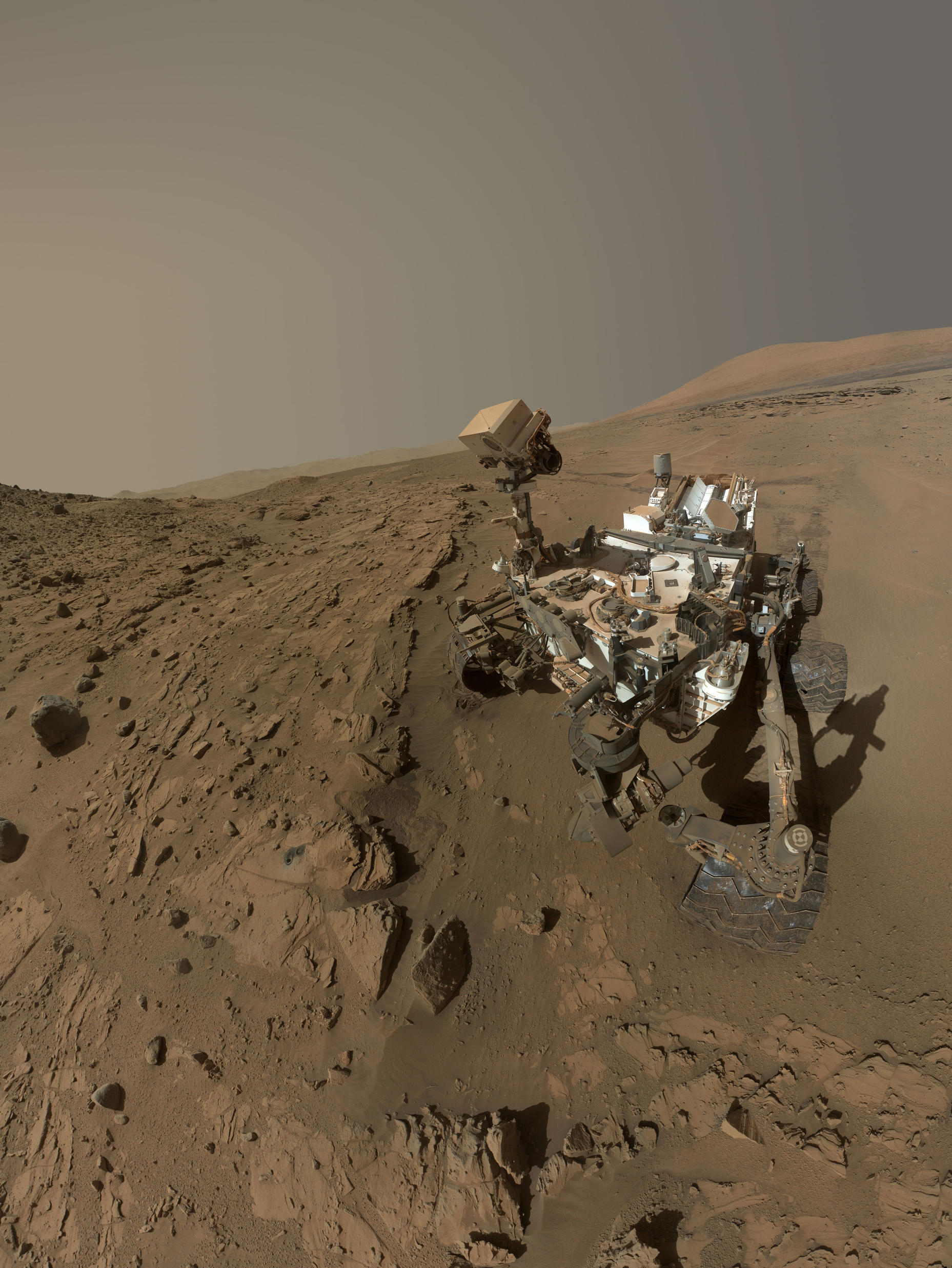
The foundation of NASA's Mars Science Laboratory mission, Curiosity was the largest and most capable rover ever sent to Mars when it launched in 2011. Curiosity set out to answer the question: Did Mars ever have the right environmental conditions to support small life forms called microbes? Early in its mission, Curiosity's scientific tools found chemical and mineral evidence of past habitable environments on Mars. It continues to explore the rock record from a time when Mars could have been home to microbial life.
Curiosity Reaches 1-Kilometer Elevation Gain
NASA’s Curiosity Mars rover reached the pinnacle — so far — of its 14-year-old mission on Aug. 26, 2026, when it marked an elevation gain of 1 kilometer in its journey from Gale Crater on Mars up the slope of Mount Sharp.
NASA’s Curiosity Finds Organic Molecules Never Seen Before on Mars
After years of lab work, the results are in: A rock that NASA’s Curiosity Mars rover drilled and analyzed in…
‘Non-Biologic Processes Don’t Fully Explain Mars Organics’
In a new study, researchers say that non-biological sources they considered could not fully account for the abundance of organic compounds in a sample collected on Mars by NASA’s Curiosity rover. A Feb. 4 report in the journal Astrobiology analyzed the discovery — the largest organic compounds found on Mars, hypothesized to possibly be fragments of fatty acids preserved in the ancient mudstone in Gale Crater.
NASA’s Curiosity Rover Sees Martian ‘Spiderwebs’ Up Close
For about six months, NASA’s Curiosity Mars rover has been exploring a region full of geologic formations called boxwork, low…
About the size of a small SUV — 10 feet long, 9 feet wide and 7 feet tall), not including the arm.
1,982 lbs (899 kg) in Earth gravity743 lbs (337 kg) in Mars gravity
Geology lab, rocker-bogie suspension, rock-vaporizing laser and lots of cameras
NASA's Curiosity Mars rover has collected 42 powderized rock samples with the drill on the end of its robotic arm. This grid shows all 42 holes made by the drill when collecting the samples.
Curiosity explores Gale Crater and acquires rock, soil, and air samples for onboard analysis. The car-size rover is about as tall as a basketball player and uses a 7 foot-long arm to place tools close to rocks selected for study. Curiosity's large size allows it to carry an advanced kit of 10 science instruments. It has tools including 17 cameras, a laser to vaporize and study small pinpoint spots of rocks at a distance, and a drill to collect powdered rock samples. It hunts for special rocks that formed in water and/or have signs of organics.The Curiosity rover has taught us a lot about the history of Mars and its potential to support life. Take a tour of its landing site, Gale Crater. Credit NASA/JPL-Caltech
Curiosity is seeking evidence of organics, the chemical building blocks of life.
View raw images sent back by Curiosity from its explorations on Mars.
Visit the one-stop-shop for all Curiosity media.
Read updates provided by self-selected Mars Science Laboratory mission team members who love to share what Curiosity is doing with the public.
Curiosity Lights Up ‘Nevado Sajama’ at Night
NASA’s Curiosity Mars rover used LED lights on the end of its robotic arm to create this rare nighttime view of the Red Planet’s surface on Dec. 6, 2025, the 4,740th Martian day, or sol, of the rover’s mission. The LED lights are part of the Mars Hand Lens Imager, or MAHLI, a camera on the end of Curiosity’s robotic arm. The image was captured by the Mast Camera, or Mastcam, on the rover’s mast, or “head.” Credits: NASA/JPL-Caltech/MSSS
NASA’s Curiosity Views a Sand-Capped Butte
NASA’s Curiosity Discovers a Field of Martian Polygons
NASA’s Curiosity Mars Rover Discovers Field of Honeycomb Textures
Establishing Crew Exposure Limits of Martian Dust
Curiosity Finds Evidence of an Ancient Sandstorm
NASA’s Mars Perseverance rover seeks signs of ancient life and collects samples of rock and regolith for possible Earth return.
Mars is the only planet we know of inhabited entirely by robots. Learn more about the Mars Missions.
Mars is the fourth planet from the Sun, and the seventh largest. It’s the only planet we know of inhabited…