top of page
space_encyclopedia_background.png

Welcome to SPACEdi's space encyclopedia profile for {objectName}. Our data engine provides object-specific articles, physical property tables, and exploration history overviews, connecting space enthusiasts, academy students, and scientific researchers to catalog imagery, structural planetary dimensions, and interactive 3D solar system models.

​

Platform Overview & Interactive Data Profiles:

​

Engineered by ARCHIMEDES Aerospace, this element bridges telemetry and ephemeris datasets with an immersive canvas interface for {Object_Name}. The interactive sandbox features:

​

  • Comprehensive Scale View: Investigate atmospheric layers, bulk composition, and surface features.

  • Voyage Planning Simulator: Deploy custom spacecraft objects to model complex orbital trajectories.

  • Integrated Scientific Engine: View related systems, natural satellites, and historical mission data from NASA, JPL, and ESA.

​

The platform supports flexible user levels—from free guest controls to saved personal libraries and academic integrations.

MAVEN is a man-made spacecraft represented in the Solar System, the region of space around the Sun, our star, within the universe. Its catalogue reference body is Mars. Explore its story and purpose, then find the spacecraft on the interactive 3D space map.

MAVEN — Investigated how Mars loses atmospheric gas to space.

Mission and scientific objectives
MAVEN is associated with NASA. Investigated how Mars loses atmospheric gas to space. The mission type is Mars atmospheric orbiter.

Mission chronology
2014: Entered Mars orbit.
2026: NASA declared the mission ended following loss of contact in December 2025.

The Mars Atmosphere and Volatile Evolution (MAVEN) mission was the first mission devoted to understanding the Martian upper atmosphere. The mission ended after more than 11 years in orbit — a decade beyond its primary, one-year mission — after it experienced an unexpected loss of signal Dec. 6, 2025, while passing behind the Red Planet.

NASA Says Farewell to MAVEN, Declares End of Mission

The first mission devoted to observing the Martian atmosphere and its evolution, NASA’s MAVEN (Mars Atmosphere and Volatile Evolution), has ended after more than 11 years in orbit at Mars and a decade beyond its primary, one-year mission. The spacecraft was heard last on Dec. 6, when it experienced an unexpected loss of signal after it passed behind the Red Planet. A review board NASA convened in February to evaluate recovery efforts and assess MAVEN’s probable current state, determined that the spacecraft is not recoverable, and is no longer capable of performing its science and data relay mission.

News and features about the mission.

Helping scientists determine what happened to the once-dense atmosphere of Mars.

Periodic updates from the mission.

Posters, 3D models, illustrations, images, graphics, selfies, and more.

Mission website from the Laboratory for Atmospheric and Space Physics (LASP), at the University of Colorado, Boulder.

Using data collected from MAVEN's Imaging Ultraviolet Spectrograph (IUVS), you can help answer questions about Mars' atmosphere and climate. Questions include:

Download the commemorative poster

Celebrating 10 Years at Mars with NASA’s MAVEN Mission

A decade ago, on Sept. 21, 2014, NASA’s MAVEN (Mars Atmospheric and Volatile EvolutioN) spacecraft entered orbit around Mars, beginning…

Mars Science Laboratory: Curiosity Rover

Part of NASA's Mars Science Laboratory mission, at the time of launch, Curiosity was the largest and most capable rover…

NASA’s Mars Perseverance rover seeks signs of ancient life and collects samples of rock and regolith for possible Earth return.

Mars Exploration: Science Goals

The key to understanding the past, present or future potential for life on Mars can be found in NASA’s four…

Mars is the fourth planet from the Sun, and the seventh largest. It’s the only planet we know of inhabited…

space_encyclopedia_background.png

MAVEN

spacecraft · Mars · Investigating how Mars lost its air.
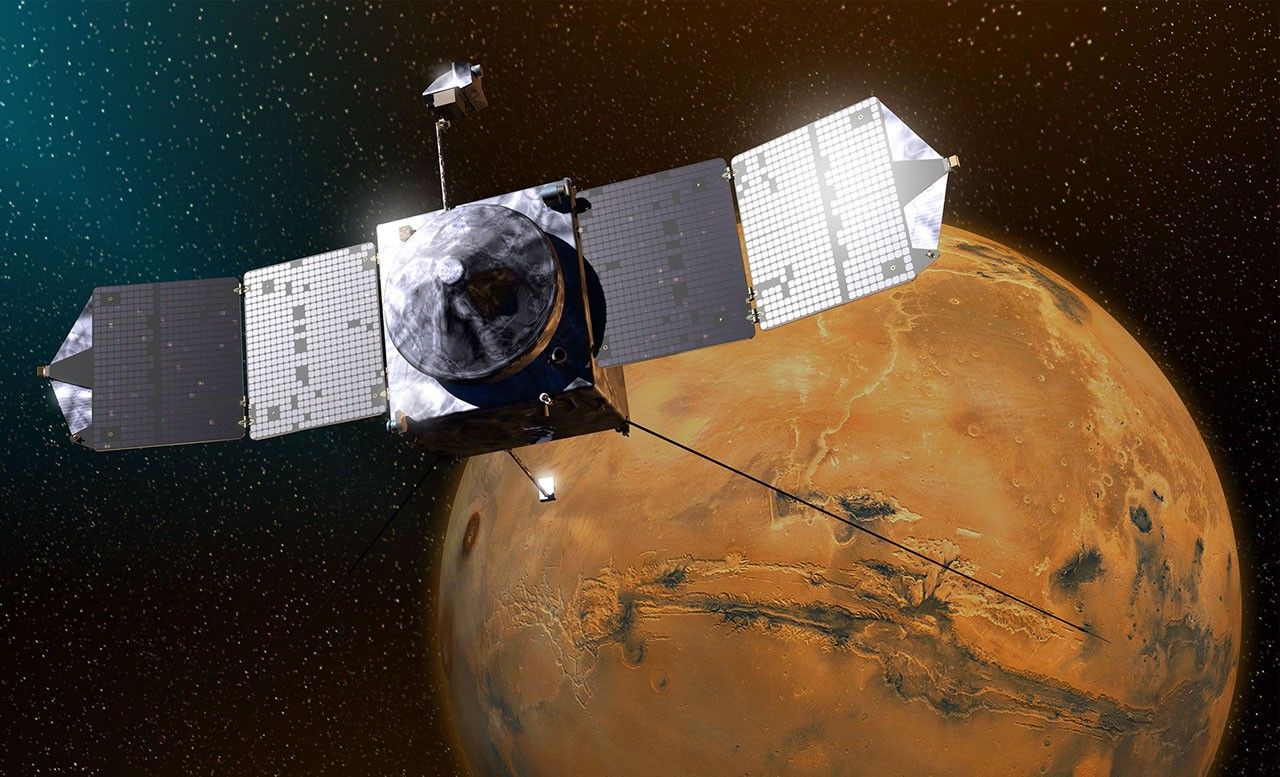
MAVEN — spacecraft

Discover the mission that studied atmospheric escape and Mars’s changing climate history, then explore its mission on the SPACE-di interactive map.

View MAVEN in the 3D Solar System

Overview

MAVEN is a man-made spacecraft represented in the Solar System, the region of space around the Sun, our star, within the universe. Its catalogue reference body is Mars. Explore its story and purpose, then find the spacecraft on the interactive 3D space map.

MAVEN — Investigated how Mars loses atmospheric gas to space.

Mission and scientific objectives

MAVEN is associated with NASA. Investigated how Mars loses atmospheric gas to space. The mission type is Mars atmospheric orbiter.

Mission chronology

2014: Entered Mars orbit.

2026: NASA declared the mission ended following loss of contact in December 2025.

The Mars Atmosphere and Volatile Evolution (MAVEN) mission was the first mission devoted to understanding the Martian upper atmosphere. The mission ended after more than 11 years in orbit — a decade beyond its primary, one-year mission — after it experienced an unexpected loss of signal Dec. 6, 2025, while passing behind the Red Planet.

NASA Says Farewell to MAVEN, Declares End of Mission

The first mission devoted to observing the Martian atmosphere and its evolution, NASA’s MAVEN (Mars Atmosphere and Volatile Evolution), has ended after more than 11 years in orbit at Mars and a decade beyond its primary, one-year mission. The spacecraft was heard last on Dec. 6, when it experienced an unexpected loss of signal after it passed behind the Red Planet. A review board NASA convened in February to evaluate recovery efforts and assess MAVEN’s probable current state, determined that the spacecraft is not recoverable, and is no longer capable of performing its science and data relay mission.

News and features about the mission.

Helping scientists determine what happened to the once-dense atmosphere of Mars.

Periodic updates from the mission.

Posters, 3D models, illustrations, images, graphics, selfies, and more.

Mission website from the Laboratory for Atmospheric and Space Physics (LASP), at the University of Colorado, Boulder.

Using data collected from MAVEN's Imaging Ultraviolet Spectrograph (IUVS), you can help answer questions about Mars' atmosphere and climate. Questions include:

Download the commemorative poster

Celebrating 10 Years at Mars with NASA’s MAVEN Mission

A decade ago, on Sept. 21, 2014, NASA’s MAVEN (Mars Atmospheric and Volatile EvolutioN) spacecraft entered orbit around Mars, beginning…

Mars Science Laboratory: Curiosity Rover

Part of NASA's Mars Science Laboratory mission, at the time of launch, Curiosity was the largest and most capable rover…

NASA’s Mars Perseverance rover seeks signs of ancient life and collects samples of rock and regolith for possible Earth return.

Mars Exploration: Science Goals

The key to understanding the past, present or future potential for life on Mars can be found in NASA’s four…

Mars is the fourth planet from the Sun, and the seventh largest. It’s the only planet we know of inhabited…

Key properties

Launch date
2013-11-18
Days since launch
4750 days
Mission organisation
NASA
Mission type
Mars atmospheric orbiter
Launch
Nov. 18, 2013

Related objects

bottom of page