


Space › Universe › Solar System › Star › Sun › Spacecraft › Voyager 1
Voyager 1
ORBITS:
Sun
SPACECRAFT
A messenger beyond the heliosphere.
Discover the probe that carried humanity’s instruments into interstellar space, then explore its mission on the SPACE-di interactive map.
naif:
-31
Reference material: NASA · NASA / Jet Propulsion Laboratory · 3D render credits
Make Voyager 1 part of your exploration…
A journey beyond the heliosphere…
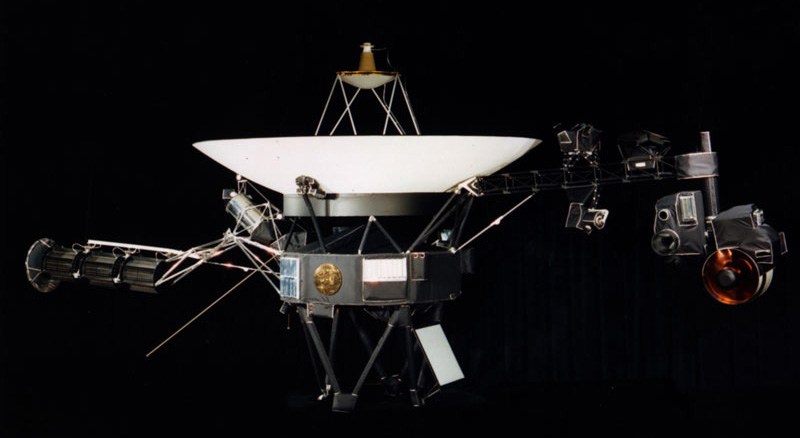
Voyager 1 is a man-made spacecraft represented in the Solar System, the region of space around the Sun, our star, within the universe. Its catalogue reference body is Sun. Explore its story and purpose, then find the spacecraft on the interactive 3D space map.
Voyager 1 — Explores the outer Solar System and the environment beyond the heliosphere.
Mission and scientific objectives
Voyager 1 is associated with NASA / Jet Propulsion Laboratory. Explores the outer Solar System and the environment beyond the heliosphere. The mission type is Interstellar probe.
Mission chronology
1979: Jupiter flyby.
1980: Saturn and Titan encounters.
2012: Entered interstellar space.
Voyager 1 and its twin Voyager 2 are the only spacecraft ever to operate outside the heliosphere, the protective bubble of particles and magnetic fields generated by the Sun. Voyager 1 reached the interstellar boundary in 2012, while Voyager 2 (traveling slower and in a different direction than its twin) reached it in 2018.
NASA Engineers Help Prolong Voyager 2’s Science Mission
Engineers at NASA’s Jet Propulsion Laboratory have successfully freed up power on Voyager 2, extending how long the spacecraft can continue…
Get the latest updates on the two Voyager spacecraft.
NASA Shuts Off Instrument on Voyager 1 to Keep Spacecraft Operating
Vintage NASA: See Voyager’s 1990 ‘Solar System Family Portrait’ Debut
NASA’s Voyager Probe Speeds Through Space (Artist’s Concept)
NASA’s Voyager 1 Revives Backup Thrusters Before Command Pause
After completing the first in-depth reconnaissance of the outer planets, the twin Voyagers are on a new mission to chart the edge of interstellar space.
The contents of the golden record were selected for NASA by a committee led by Carl Sagan of Cornell University.
The twin Voyagers are escaping our solar system in different directions at more than 3 astronomical units (AU) per year; 1 AU is the distance from Earth to the Sun, or about 93 million miles.
The behind-the-scenes story of the making of Voyager 1's iconic image of Earth as "a mote of dust suspended in a sunbeam," captured as the spacecraft looked homeward from 3.7 billion miles away.