


Space › Universe › Solar System › Star › Sun › Planet › Saturn › Moon › Titan
Titan
ORBITS:
Saturn
MOON
A golden haze above lakes of methane.
Discover Saturn’s largest moon, with its thick atmosphere and hydrocarbon lakes, then explore its place in the Solar System on the SPACE-di interactive map.
naif:
606
Reference material: NASA / Jet Propulsion Laboratory · NASA · 3D render credits
Make Titan part of your exploration…
Titan: a companion of Saturn…
Titan is a moon of Saturn, part of the Solar System in the universe. Saturn is a planet associated with the Sun, our star, and this space encyclopedia describes the moon’s identity and place in its planetary system.
Titan has a dense nitrogen atmosphere and an active methane cycle with clouds, rain, rivers, lakes and seas. It is the only moon known to have a stable, Earth-like surface liquid cycle, although its liquid is hydrocarbons rather than water.
Atmosphere: mainly nitrogen (N₂), with methane (CH₄) and organic compounds; proportions vary with altitude. Surface: water ice, liquid methane/ethane (C₂H₆) and organic deposits. Atmosphere measurements are not bulk composition.
Discovery and designation
Titan was discovered in 1655. JPL credits C. Huygens. The name and discovery entry identify this particular satellite of Saturn; similarly named asteroids are separate objects.
Titan is Saturn’s largest moon. It has an earthlike cycle of liquids flowing across its surface. It is the only moon with a thick atmosphere.
Titan is the target of NASA's upcoming Dragonfly mission.
Titan is Saturn's largest moon, and the only moon in our solar system known to have a substantial atmosphere. Titan is the only place besides Earth known to have liquids on its surface. It has clouds, rain, rivers, lakes and seas of liquid hydrocarbons like methane and ethane.
The first spacecraft to explore Titan, Pioneer 11, flew through the Saturn system on Sept. 1, 1979.
NASA’s Dragonfly rotorcraft will launch to Titan in 2028, and spend three years making multiple landings to investigate prebiotic chemical processes and complex organic compounds that, on Earth, are the building blocks of life.
Eyes on the Solar System: Titan
NASA’s Dragonfly Gets Wired Up While Titan Landing Area Is Named
NASA’s Dragonfly Clears Key Tests as Titan Rotorcraft Takes Shape
NASA’s Dragonfly Flight System Faces Heat
NASA’s Dragonfly Rotorcraft Gets Decked Out, Tested
NASA’s Dragonfly Mission Begins Rotorcraft Integration, Testing Stage
Saturn and Titan Resource Package
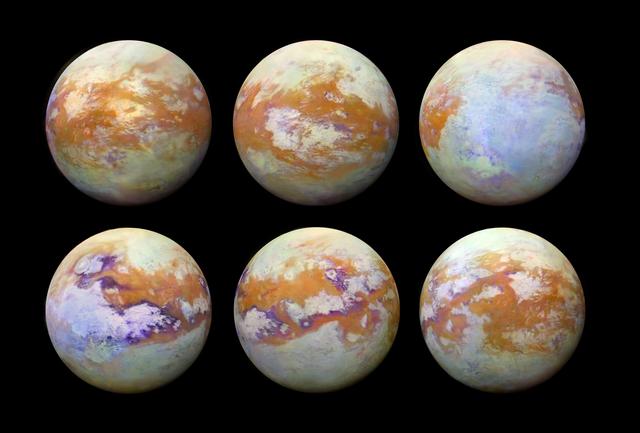
Images of Titan from NASA spacecraft.
Making multiple flights, the Dragonfly rotorcraft will explore a variety of locations on Saturn's moon Titan.
Latest updates on the Dragonfly mission.