top of page
space_encyclopedia_background.png

Welcome to SPACEdi's space encyclopedia profile for {objectName}. Our data engine provides object-specific articles, physical property tables, and exploration history overviews, connecting space enthusiasts, academy students, and scientific researchers to catalog imagery, structural planetary dimensions, and interactive 3D solar system models.

​

Platform Overview & Interactive Data Profiles:

​

Engineered by ARCHIMEDES Aerospace, this element bridges telemetry and ephemeris datasets with an immersive canvas interface for {Object_Name}. The interactive sandbox features:

​

  • Comprehensive Scale View: Investigate atmospheric layers, bulk composition, and surface features.

  • Voyage Planning Simulator: Deploy custom spacecraft objects to model complex orbital trajectories.

  • Integrated Scientific Engine: View related systems, natural satellites, and historical mission data from NASA, JPL, and ESA.

​

The platform supports flexible user levels—from free guest controls to saved personal libraries and academic integrations.

Europa Clipper is a man-made spacecraft represented in the Solar System, the region of space around the Sun, our star, within the universe. Its catalogue reference body is Sun. Explore its story and purpose, then find the spacecraft on the interactive 3D space map.

Europa Clipper — Designed to investigate Europa’s ice shell, ocean and potential habitability.

Mission and scientific objectives
Europa Clipper is associated with NASA / Jet Propulsion Laboratory. Designed to investigate Europa’s ice shell, ocean and potential habitability. The mission type is Europa exploration probe.

Mission chronology
2030: Planned arrival at Jupiter.

Europa Clipper launched Oct. 14, 2024, on a journey to explore Europa, Jupiter's ocean world.

Europa Clipper is the first mission designed to conduct a detailed study of Jupiter's moon Europa. There’s scientific evidence that the ingredients for life may exist on Europa right now. The spacecraft will travel 1.8 billion miles (2.9 billion kilometers) to reach Jupiter in April 2030. It will orbit Jupiter, and conduct 49 close flybys of Europa.

Europa Clipper will try to determine if Jupiter's icy moon Europa currently has habitable conditions.

Europa Clipper lifted off aboard a SpaceX Falcon Heavy rocket from Launch Complex 39A at Kennedy Space Center in Florida at 12:06 p.m. EDT on Oct. 14, 2024. Europa Clipper is traveling 1.8 billion miles (2.9 billion km) to reach Jupiter in April 2030. The spacecraft will orbit Jupiter, and conduct 49 close flybys of Europa. The spacecraft carries nine science instruments, and a gravity experiment that uses the telecommunications system. All science instruments will operate simultaneously on every pass.

What is Europa Clipper's main science goal?

Europa Clipper’s main science goal is to determine whether there are places below the surface of Jupiter’s icy moon, Europa, that could support life.

Meet the Europa Clipper Spacecraft

Europa Clipper is a robotic solar-powered spacecraft built to conduct the first detailed investigations of Jupiter's icy moon Europa.

With its solar arrays deployed, Europa Clipper spans more than 100 feet (about 30 meters) – about the length of a basketball court. The main body of the spacecraft consists of its avionics vault, radio frequency module, and propulsion module.

The search for life beyond Earth is one of NASA’s primary objectives.

If humans are to truly understand our place in the universe, we must learn whether our planet is the only place where life exists. So the search is on! There is strong evidence Jupiter's moon Europa has a saltwater ocean that may be one of the best places to look for environments where life could exist beyond Earth.

Europa Clipper Misión en Español

Todo sobre la luna de Júpiter Europa y la misión Europa Clipper de la NASA.

Europa Clipper’s Vault Plate Installed

Developing Robust Electronics That Can Withstand Harsh Conditions on Cold Planetary Bodies

NASA’s Galileo Mission Points to Ammonia at Europa, Recent Study Shows

NASA’s Europa Clipper Observes Comet 3I/ATLAS

Europa Clipper Captures Uranus With Star Tracker Camera

NASA’s Europa Clipper Radar Instrument Proves Itself at Mars

space_encyclopedia_background.png

Europa Clipper

spacecraft · Sun · Following the clues beneath Europa’s ice.
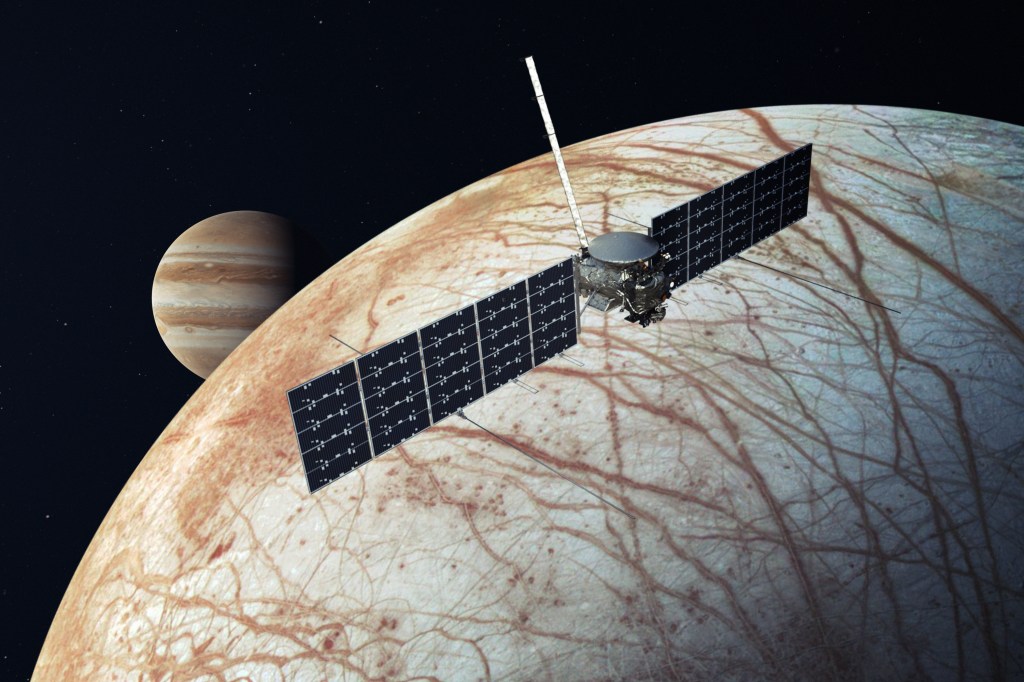
Europa Clipper — spacecraft

Discover the mission designed to investigate Europa’s ice shell and ocean, then explore its mission on the SPACE-di interactive map.

View Europa Clipper in the 3D Solar System

Overview

Europa Clipper is a man-made spacecraft represented in the Solar System, the region of space around the Sun, our star, within the universe. Its catalogue reference body is Sun. Explore its story and purpose, then find the spacecraft on the interactive 3D space map.

Europa Clipper — Designed to investigate Europa’s ice shell, ocean and potential habitability.

Mission and scientific objectives

Europa Clipper is associated with NASA / Jet Propulsion Laboratory. Designed to investigate Europa’s ice shell, ocean and potential habitability. The mission type is Europa exploration probe.

Mission chronology

2030: Planned arrival at Jupiter.

Europa Clipper launched Oct. 14, 2024, on a journey to explore Europa, Jupiter's ocean world.

Europa Clipper is the first mission designed to conduct a detailed study of Jupiter's moon Europa. There’s scientific evidence that the ingredients for life may exist on Europa right now. The spacecraft will travel 1.8 billion miles (2.9 billion kilometers) to reach Jupiter in April 2030. It will orbit Jupiter, and conduct 49 close flybys of Europa.

Europa Clipper will try to determine if Jupiter's icy moon Europa currently has habitable conditions.

Europa Clipper lifted off aboard a SpaceX Falcon Heavy rocket from Launch Complex 39A at Kennedy Space Center in Florida at 12:06 p.m. EDT on Oct. 14, 2024. Europa Clipper is traveling 1.8 billion miles (2.9 billion km) to reach Jupiter in April 2030. The spacecraft will orbit Jupiter, and conduct 49 close flybys of Europa. The spacecraft carries nine science instruments, and a gravity experiment that uses the telecommunications system. All science instruments will operate simultaneously on every pass.

What is Europa Clipper's main science goal?

Europa Clipper’s main science goal is to determine whether there are places below the surface of Jupiter’s icy moon, Europa, that could support life.

Meet the Europa Clipper Spacecraft

Europa Clipper is a robotic solar-powered spacecraft built to conduct the first detailed investigations of Jupiter's icy moon Europa.

With its solar arrays deployed, Europa Clipper spans more than 100 feet (about 30 meters) – about the length of a basketball court. The main body of the spacecraft consists of its avionics vault, radio frequency module, and propulsion module.

The search for life beyond Earth is one of NASA’s primary objectives.

If humans are to truly understand our place in the universe, we must learn whether our planet is the only place where life exists. So the search is on! There is strong evidence Jupiter's moon Europa has a saltwater ocean that may be one of the best places to look for environments where life could exist beyond Earth.

Europa Clipper Misión en Español

Todo sobre la luna de Júpiter Europa y la misión Europa Clipper de la NASA.

Europa Clipper’s Vault Plate Installed

Developing Robust Electronics That Can Withstand Harsh Conditions on Cold Planetary Bodies

NASA’s Galileo Mission Points to Ammonia at Europa, Recent Study Shows

NASA’s Europa Clipper Observes Comet 3I/ATLAS

Europa Clipper Captures Uranus With Star Tracker Camera

NASA’s Europa Clipper Radar Instrument Proves Itself at Mars

Key properties

Launch date
2024-10-14
Days since launch
767 days
Mission organisation
NASA / Jet Propulsion Laboratory
Mission type
Europa exploration probe
Launch
14 October 2024

Related objects

bottom of page