


Space › Universe › Solar System › Star › Sun › Planet › Jupiter › Moon › Europa
Europa
ORBITS:
Jupiter
MOON
An icy surface. An ocean to investigate.
Discover Jupiter’s fractured ice moon and the evidence for an ocean beneath its crust, then explore its place in the Solar System on the SPACE-di interactive map.
naif:
502
Reference material: NASA / Jet Propulsion Laboratory · NASA · 3D render credits
Make Europa part of your exploration…
Europa: a companion of Jupiter…
Europa is a moon of Jupiter, part of the Solar System in the universe. Jupiter is a planet associated with the Sun, our star, and this space encyclopedia describes the moon’s identity and place in its planetary system.
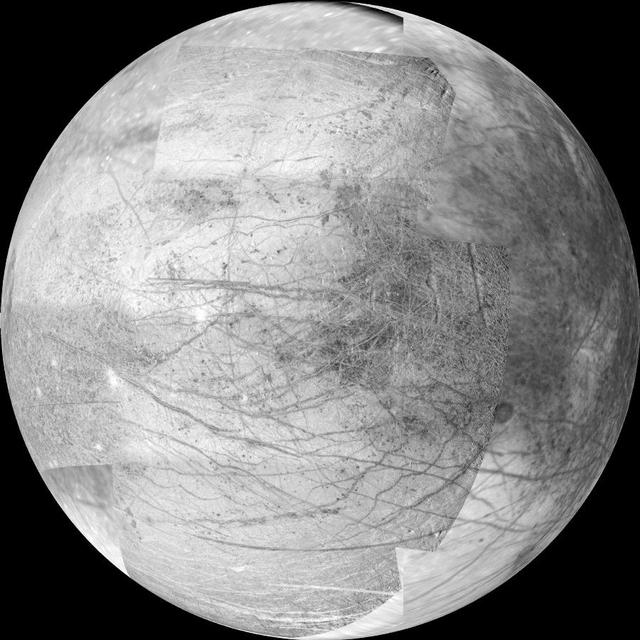
Europa has a water-ice shell over a likely global saltwater ocean. Its potential habitability has made it one of the highest-priority destinations for planetary science.
Water-ice shell above an inferred salty water ocean. Exact ocean abundances and a complete bulk elemental inventory remain uncertain.
Discovery and designation
Europa was discovered in 1610. JPL credits Galileo. The name and discovery entry identify this particular satellite of Jupiter; similarly named asteroids are separate objects.
There is strong evidence Jupiter's moon Europa has a saltwater ocean that may be one of the best places to look for environments where life could exist beyond Earth.
Europa is the fourth largest of Jupiter’s 95 moons. It's the sixth-closest moon to the planet.
Europa may be one of the most promising places in our solar system to find present-day environments suitable for some form of life beyond Earth. Scientists believe a saltwater ocean lies beneath its icy shell, holding twice as much water as Earth's global ocean. It also may have the chemical elements that are key ingredients to life. NASA launched Europa Clipper on Oct. 14, 2024, to determine whether there are places below Europa's surface that could support life.
NASA's Europa Clipper launched on Oct. 14, 2024, on the first mission to conduct a detailed science investigation of Europa.
Six robotic spacecraft have explored Europa, and scientists do regular observations of the moon with Hubble Space Telescope. Europa was first observed up close during the Jupiter flybys of Pioneer 10, Pioneer 11, Voyager 1 and Voyager 2. Most of what we know about the moon comes from observations by the Galileo mission. NASA's Juno spacecraft is orbiting Jupiter, and has made close flybys of Europa.
Eyes on the Solar System: Europa
NASA Samples Antarctic Water to Inform Search for Life on Icy Worlds
Ammonia-Bearing Compounds Discovered at Surface of Jupiter’s Moon Europa
Europa’s Ice Shell (Artist’s Concept)
NASA’s Galileo Mission Points to Ammonia at Europa, Recent Study Shows
NASA’s Juno Measures Thickness of Europa’s Ice Shell
Europa Clipper’s main science goal is to determine whether there are places below the surface of Jupiter’s icy moon, Europa, that could support life.
Images of Europa from NASA spacecraft.