top of page
space_encyclopedia_background.png

Welcome to SPACEdi's space encyclopedia profile for {objectName}. Our data engine provides object-specific articles, physical property tables, and exploration history overviews, connecting space enthusiasts, academy students, and scientific researchers to catalog imagery, structural planetary dimensions, and interactive 3D solar system models.

​

Platform Overview & Interactive Data Profiles:

​

Engineered by ARCHIMEDES Aerospace, this element bridges telemetry and ephemeris datasets with an immersive canvas interface for {Object_Name}. The interactive sandbox features:

​

  • Comprehensive Scale View: Investigate atmospheric layers, bulk composition, and surface features.

  • Voyage Planning Simulator: Deploy custom spacecraft objects to model complex orbital trajectories.

  • Integrated Scientific Engine: View related systems, natural satellites, and historical mission data from NASA, JPL, and ESA.

​

The platform supports flexible user levels—from free guest controls to saved personal libraries and academic integrations.

Umbriel is a moon of Uranus, part of the Solar System in the universe. Uranus is a planet associated with the Sun, our star, and this space encyclopedia describes the moon’s identity and place in its planetary system.

Umbriel — A natural satellite of Uranus. Its physical properties and orbital motion are shown from the available catalogue and ephemeris data.

No object-specific chemical/elemental dataset has been verified and imported for this record. This does not mean none is publicly available. Appearance may be imagined; chemistry is not.

Discovery and designation
Umbriel was discovered in 1851. JPL credits W. Lassell. The name and discovery entry identify this particular satellite of Uranus; similarly named asteroids are separate objects.

Umbriel was discovered on Oct. 24, 1851 by English astronomer William Lassell.

Umbriel is the darkest of Uranus' largest moons. It reflects only 16 percent of the light that strikes its surface, a feature similar to the highland areas of Earth's Moon. Other Uranian moons are much brighter. The process by which Umbriel's ancient cratered surface was darkened remains a mystery.

Umbriel has a diameter of about 750 miles (1,200 kilometers). Images taken by Voyager 2 in 1986 revealed a curious bright ring about 90 miles (140 kilometers) in diameter on the moon's dark surface. It is unclear what created the distinctive ring, although it may be frost deposits associated with an impact crater.

Umbriel is named for a malevolent spirit in English poet Alexander Pope's 18th century poem "Rape of the Lock."

space_encyclopedia_background.png

Umbriel

moon · Uranus · Umbriel. A 1851 discovery in Uranus’s skies.
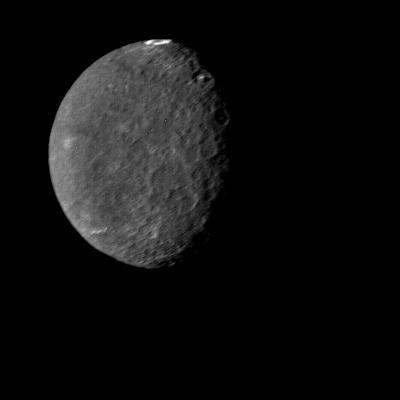
Umbriel at Closest Approach

Discover Umbriel, a moon of Uranus with an orbital semi-major axis of about 265,986 km, discovered in 1851, then explore its place in the Solar System on the SPACE-di interactive map.

View Umbriel in the 3D Solar System

Overview

Umbriel is a moon of Uranus, part of the Solar System in the universe. Uranus is a planet associated with the Sun, our star, and this space encyclopedia describes the moon’s identity and place in its planetary system.

Umbriel — A natural satellite of Uranus. Its physical properties and orbital motion are shown from the available catalogue and ephemeris data.

No object-specific chemical/elemental dataset has been verified and imported for this record. This does not mean none is publicly available. Appearance may be imagined; chemistry is not.

Discovery and designation

Umbriel was discovered in 1851. JPL credits W. Lassell. The name and discovery entry identify this particular satellite of Uranus; similarly named asteroids are separate objects.

Umbriel was discovered on Oct. 24, 1851 by English astronomer William Lassell.

Umbriel is the darkest of Uranus' largest moons. It reflects only 16 percent of the light that strikes its surface, a feature similar to the highland areas of Earth's Moon. Other Uranian moons are much brighter. The process by which Umbriel's ancient cratered surface was darkened remains a mystery.

Umbriel has a diameter of about 750 miles (1,200 kilometers). Images taken by Voyager 2 in 1986 revealed a curious bright ring about 90 miles (140 kilometers) in diameter on the moon's dark surface. It is unclear what created the distinctive ring, although it may be frost deposits associated with an impact crater.

Umbriel is named for a malevolent spirit in English poet Alexander Pope's 18th century poem "Rape of the Lock."

Key properties

Mean radius
584.7 km
Orbital period
4.144177 days

Exploration history

William Lassell discovered Umbriel in 1851. Voyager 2 observations revealed a dark, cratered moon with a conspicuous bright ring-shaped feature.

bottom of page