


Space › Universe › Solar System › Star › Sun › Spacecraft › SOHO
SOHO
ORBITS:
Sun
SPACECRAFT
Watching the Sun from within and beyond.
Discover the observatory studying the solar interior, atmosphere and wind, then explore its mission on the SPACE-di interactive map.
naif:
-21
Reference material: NASA · NASA / Jet Propulsion Laboratory · 3D render credits
Make SOHO part of your exploration…
SOHO: a mission of discovery…
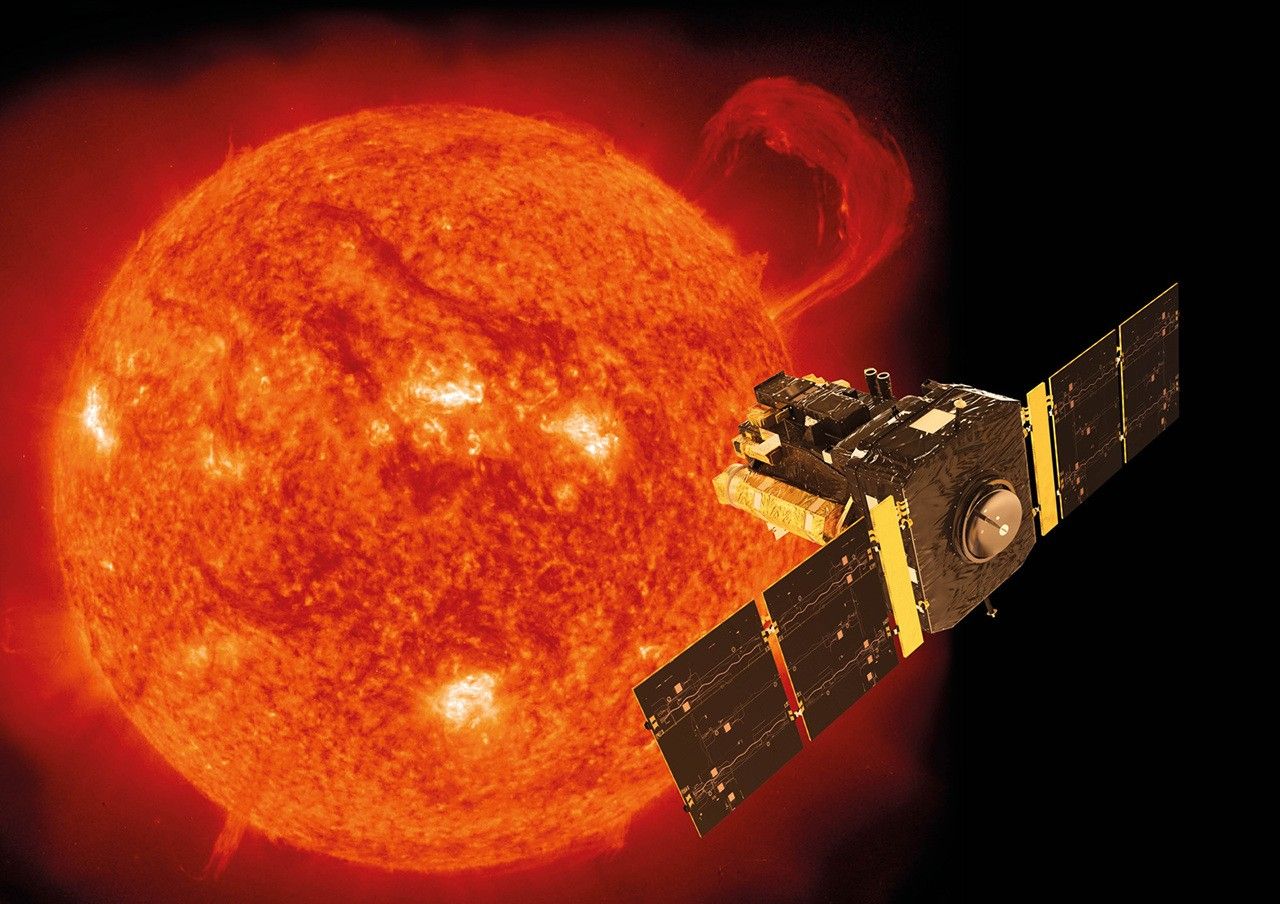
SOHO is a man-made spacecraft represented in the Solar System, the region of space around the Sun, our star, within the universe. Its catalogue reference body is Sun. Explore its story and purpose, then find the spacecraft on the interactive 3D space map.
SOHO — Studies the Sun’s interior, atmosphere and solar wind from the Sun–Earth L1 region.
Mission and scientific objectives
SOHO is associated with European Space Agency / NASA. Studies the Sun’s interior, atmosphere and solar wind from the Sun–Earth L1 region. The mission type is Solar observatory.
Solar and Heliospheric Observatory
Launched in December 1995, the joint ESA-NASA Solar and Heliospheric Observatory mission (SOHO), was designed to study the Sun inside out. Though its mission was scheduled to run until only 1998, it has continued collecting data, adding to scientists' understanding of our closest star, and making many new discoveries, including more than 5,000 comets.
SOHO is the longest-lived Sun-watching satellite to date. Numerous mission extensions have enabled the spacecraft to observe two 11-year solar cycles and to discover thousands of comets.
Feb. 14, 1996: Sun-Earth L1 orbit insertion
March 25, 2024: 5,000 comets discovered
The ESA-sponsored Solar and Heliospheric Observatory (SOHO) carries 12 scientific instruments to study the solar atmosphere, helioseismology, and the solar wind. Information from the mission has allowed scientists to learn more about the Sun’s internal structure and dynamics, the chromosphere, the corona, and solar particles.
The SOHO and Cluster missions, part of ESA’s Solar Terrestrial Science Programme (STSP), are ESA’s contributions to the International Solar Terrestrial Physics (ISTP) program, which has involved the work of other spacecraft such as Wind and ACE, which, like SOHO, operate in the vicinity of the Sun-Earth L1 point.
NASA contributed three instruments to SOHO as well as launch and flight operations support.
About two months after launch, on Feb. 14, 1996, SOHO was placed at a distance of 932,000 miles (1.5 million kilometers) from Earth in an elliptical Lissajous orbit around the L1 libration point where it takes approximately six months to orbit L1 (while the L1 itself orbits the Sun every 12 months).
The spacecraft returned its first image Dec. 19, 1995, and was fully commissioned for operations by April 16, 1996. SOHO finished its planned two-year study of the Sun’s atmosphere, surface, and interior in April 1998.
Communications with the spacecraft were interrupted for four months beginning June 24, 1998, after which the spacecraft was apparently spinning, losing electrical power, and not pointing at the Sun. After intensive search efforts, by Sept. 25, 1998, controllers managed to regain control and return SOHO to “normal mode.” Except for three instruments, the spacecraft was functional and was declared operational once again by mid-October 1998.
Because of the failure of onboard gyros, ESA developed a special method of orientation, using reaction wheels instead of gyros, which was successfully implemented beginning Feb. 1, 1999.
SOHO’s original lifetime was three years (to 1998), but SOHO’s mission at L1 has been extended several times and continues to provide valuable information about the Sun.
One of SOHO’s most important discoveries has been locating the origin of the fast solar wind at the corners of honeycomb-shaped magnetic fields surrounding the edges of large bubbling cells located near the Sun’s poles.
Another has been its discovery, as of March 2024, of over 5,000 comets (more than one-half of all known comets), by over 70 people representing 18 different nations. These discoveries were made possible because of the LASCO instrument that blocks out the Sun’s glare, rendering comets visible.
In December 2025, SOHO marked 30 years of continuous operation, having fundamentally changed our conception of the Sun “from a picture of a static, unchanging object in the sky to the dynamic beast it is,” in the words of Bernhard Fleck, the ESA project scientist for SOHO.
The longevity of the mission has allowed SOHO to cover two full 11-year solar cycles and most of a third one. One of the high points of the mission was SOHO’s observation of a bright comet plunging toward the Sun on Aug. 3-4, 2016, at a velocity of nearly 1.3 million miles per hour (2.1 million kilometers per hour).
National Space Science Data Center Master Catalog: SOHO
Siddiqi, Asif A. Beyond Earth: A Chronicle of Deep Space Exploration, 1958-2016. NASA History Program Office, 2018.
NASA Heliophysics Spacecraft Witness Comet’s Demise
NASA’s PUNCH Tracks Comet Discovered by SOHO Spacecraft
NASA, ESA Sun Observatory Marks 30 Years
NASA/ESA’s SOHO Observes Interstellar Comet 3I/ATLAS
View Interstellar Comet 3I/ATLAS Through NASA’s Multiple Lenses
Webb is the premier observatory of the next decade, serving thousands of astronomers worldwide. It studies every phase in the…
This rover and its aerial sidekick were assigned to study the geology of Mars and seek signs of ancient microbial…
On a mission to “touch the Sun,” NASA's Parker Solar Probe became the first spacecraft to fly through the corona…
NASA’s Juno spacecraft entered orbit around Jupiter in 2016, the first explorer to peer below the planet's dense clouds to…