


Space › Universe › Solar System › Star › Sun › Spacecraft › Parker Solar Probe
Parker Solar Probe
ORBITS:
Sun
SPACECRAFT
Into the Sun’s outer atmosphere.
Discover the probe built to measure the solar corona and the origins of the solar wind, then explore its mission on the SPACE-di interactive map.
naif:
-96
Reference material: NASA · NASA / Jet Propulsion Laboratory · 3D render credits
Make Parker Solar Probe part of your exploration…
A closer encounter with our star…
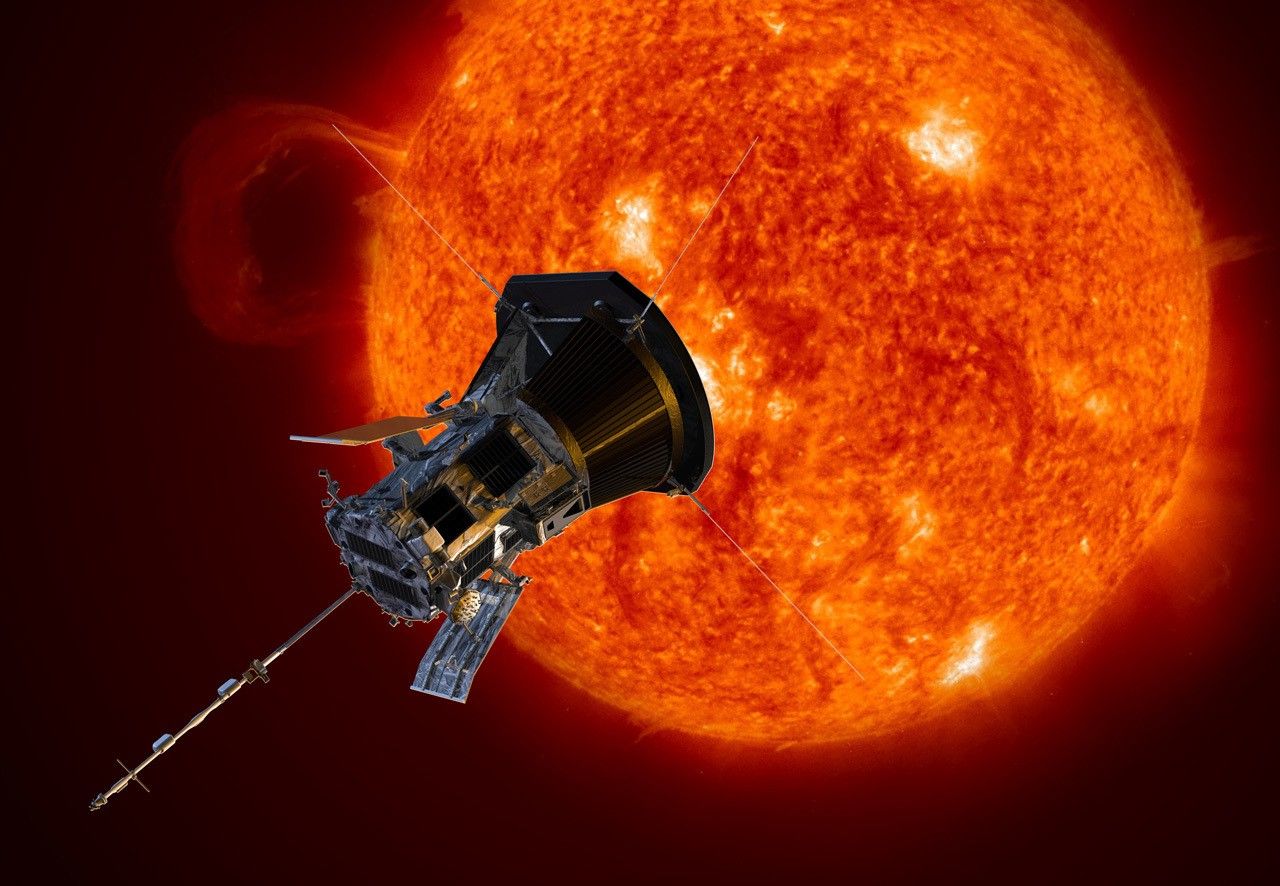
Parker Solar Probe is a man-made spacecraft represented in the Solar System, the region of space around the Sun, our star, within the universe. Its catalogue reference body is Sun. Explore its story and purpose, then find the spacecraft on the interactive 3D space map.
Parker Solar Probe — Measures the solar corona, solar wind and energetic particles.
Mission and scientific objectives
Parker Solar Probe is associated with NASA / Johns Hopkins Applied Physics Laboratory. Measures the solar corona, solar wind and energetic particles. The mission type is Solar probe.
On a mission to “touch the Sun,” NASA's Parker Solar Probe became the first spacecraft to fly through the corona — the Sun’s upper atmosphere — in 2021. With every orbit bringing it closer, the probe faces brutal heat and radiation to provide humanity with unprecedented observations, visiting the only star we can study up close.
NASA's Parker Solar Probe will revolutionize our understanding of the Sun. The spacecraft is gradually orbiting closer to the Sun’s surface than any before it — well within the orbit of Mercury. Flying into the outermost part of the Sun's atmosphere, the corona, for the first time, Parker Solar Probe is collecting measurements and images to expand our knowledge of the origin and evolution of solar wind. It also makes critical contributions to forecasting changes in the space environment that affect life and technology on Earth.
At closest approach, Parker Solar Probe hurtles around the Sun at approximately 430,000 mph (700,000 kph). That's fast enough to get from Philadelphia to Washington, D.C., in one second.
To perform its unprecedented investigations, the Parker Solar Probe and its instruments are protected from the Sun by a 4.5-inch-thick (11.43 cm) carbon-composite shield, which can withstand temperatures reaching nearly 2,500 degrees Fahrenheit (1,377 Celsius).
Read up-to-date information on the latest from this record-breaking mission as it journeys close to the Sun.
NASA's Parker Solar Probe is diving into the Sun’s atmosphere, facing brutal heat and radiation, on a mission to give humanity its first-ever sampling of a star’s atmosphere.
On Dec. 14, 2021, NASA announced that Parker had flown through the Sun’s upper atmosphere – the corona – and sampled particles and magnetic fields there. This marked the first time in history, a spacecraft had touched the Sun.
Parker Solar Probe is designed to swoop within about 4 million miles (6.5 million kilometers) of the Sun's surface to trace the flow of energy, to study the heating of the solar corona, and to explore what accelerates the solar wind.
During its journey, the mission will provide answers to long-standing questions that have puzzled scientists for more than 60 years: Why is the corona much hotter than the Sun's surface (the photosphere)? How does the solar wind accelerate? What are the sources of high-energy solar particles?
We live in the Sun's atmosphere and this mission will help scientists better understand the Sun's impact on Earth. Data from Parker will be key to understanding and, perhaps, forecasting space weather. Space weather can change the orbits of satellites, shorten their lifetimes, or interfere with onboard electronics.
Parker can survive the Sun's harsh conditions because cutting-edge thermal engineering advances protect the spacecraft during its dangerous journey.
The probe has four instrument suites designed to study magnetic fields, plasma, and energetic particles, and image the solar wind.
The mission is named for the late Dr. Eugene N. Parker, who pioneered our modern understanding of the Sun. As a young professor at the University of Chicago in the mid-1950s, Parker developed a mathematical theory that predicted the solar wind, the constant outflow of solar material from the Sun. Throughout his career, Parker revolutionized the field time and again, advancing ideas that addressed the fundamental questions about the workings of our Sun and stars throughout the universe.
He died March 15, 2022, at age 94.
In 2018, Parker became the first person to witness the launch of a spacecraft bearing his name. NASA’s Parker Solar Probe continues its mission today in pursuit of the pioneering questions Parker first envisaged more than a half century ago.
On Oct. 3, 2017, Eugene N. Parker, professor emeritus at the University of Chicago, visited the spacecraft that bears his name: NASA’s Parker Solar Probe. This is the first NASA mission named for a living researcher and it's humanity’s first mission to explore the Sun up close.
After Latest Swing Past Sun, NASA’s Parker Solar Probe Checks in
Parker Solar Probe Makes 28th Close Pass of Sun
NASA Missions Track Record-Breaking Radio Burst from Sun
NASA’s Parker Solar Probe Finds Surprises in an Explosion Near the Sun
NASA’s Parker Solar Probe Makes 27th Swing Around the Sun
Webb is the premier observatory of the next decade, serving thousands of astronomers worldwide. It studies every phase in the…
This rover and its aerial sidekick were assigned to study the geology of Mars and seek signs of ancient microbial…
SOHO is the longest-lived Sun-watching satellite to date.
NASA’s Juno spacecraft entered orbit around Jupiter in 2016, the first explorer to peer below the planet's dense clouds to…