


Space › Universe › Solar System › Star › Sun › Planet › Saturn › Moon › Pan
Pan
ORBITS:
Saturn
MOON
A tiny moon with a remarkable equatorial ridge.
Discover the ridge-bearing moon that travels through Saturn’s Encke Gap, then explore its place in the Solar System on the SPACE-di interactive map.
naif:
618
Reference material: NASA / Jet Propulsion Laboratory · NASA · 3D render credits
Make Pan part of your exploration…
Pan: a companion of Saturn…
Pan is a moon of Saturn, part of the Solar System in the universe. Saturn is a planet associated with the Sun, our star, and this space encyclopedia describes the moon’s identity and place in its planetary system.
Pan — A natural satellite of Saturn. Its physical properties and orbital motion are shown from the available catalogue and ephemeris data.
No object-specific chemical/elemental dataset has been verified and imported for this record. This does not mean none is publicly available. Appearance may be imagined; chemistry is not.
Discovery and designation
Pan was discovered in 1990. JPL credits M.R. Showalter. Its provisional designation is S/1981 S13. The name and discovery entry identify this particular satellite of Saturn; similarly named asteroids are separate objects.
Pan was discovered by M.R. Showalter in 1990 using images taken by the Voyager 2 spacecraft nine years earlier.
Pan, the innermost of Saturn's known moons, has a mean radius of 8.8 miles (14.1 kilometers) and orbits 83,000 miles (134,000 kilometers) away from Saturn, within the Encke Gap of Saturn's A-ring. As it orbits Saturn every 13.8 hours, it acts as a shepherd moon and is responsible for keeping the Encke Gap open. The gap is a 200 mile (325 kilometer) opening in Saturn's A ring.
Pan creates stripes, called "wakes," in the ring material on either side of it. Since ring particles closer to Saturn than Pan move faster in their orbits, these particles pass the moon and receive a gravitational "kick" from Pan as they do. This kick causes waves to develop in the gap and also throughout the ring, extending hundreds of miles into the rings. These waves intersect downstream to create the wakes, places where ring material has bunched up in an orderly manner thanks to Pan's gravitational kick.
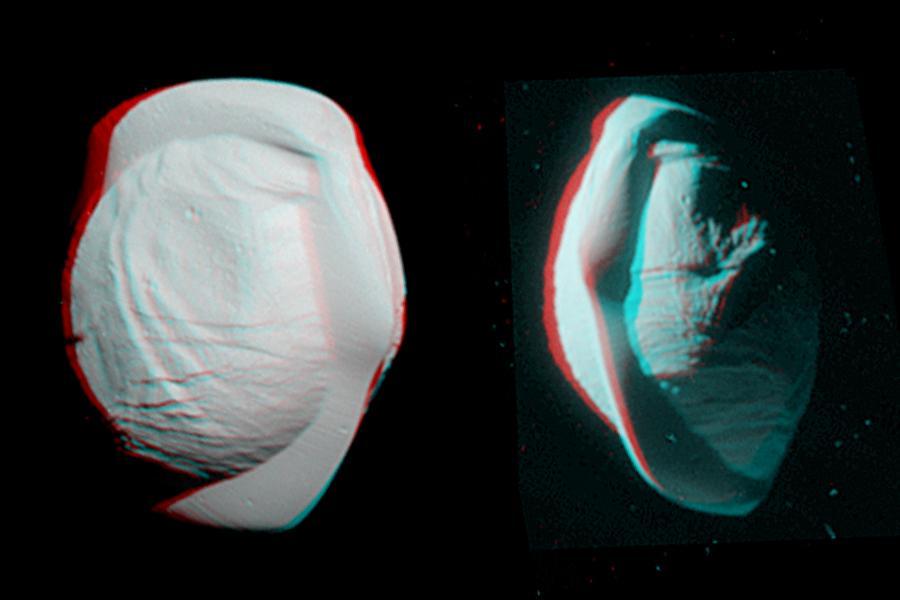
Pan, like Saturn's moon Atlas, has a prominent equatorial ridge that gives it a distinctive flying saucer shape.
Moons of Saturn were originally named for Greco-Roman Titans and descendants of the Titans. But as many new moons were discovered scientists began selecting names from more mythologies, including Gallic, Inuit and Norse stories.
Pan, a satyr (a creature resembling a man with the hind legs and hooves of a goat), is a Greek god of nature and the forest.