


Space › Universe › Solar System › Star › Sun › Planet › Uranus › Moon › Oberon
Oberon
ORBITS:
Uranus
MOON
Oberon. A 1787 discovery in Uranus’s skies.
Discover Oberon, a moon of Uranus with an orbital semi-major axis of about 583,511 km, discovered in 1787, then explore its place in the Solar System on the SPACE-di interactive map.
naif:
704
Reference material: NASA / Jet Propulsion Laboratory · NASA · 3D render credits
Make Oberon part of your exploration…
Oberon: a companion of Uranus…
Oberon is a moon of Uranus, part of the Solar System in the universe. Uranus is a planet associated with the Sun, our star, and this space encyclopedia describes the moon’s identity and place in its planetary system.
Oberon — A natural satellite of Uranus. Its physical properties and orbital motion are shown from the available catalogue and ephemeris data.
No object-specific chemical/elemental dataset has been verified and imported for this record. This does not mean none is publicly available. Appearance may be imagined; chemistry is not.
Discovery and designation
Oberon was discovered in 1787. JPL credits W. Herschel. The name and discovery entry identify this particular satellite of Uranus; similarly named asteroids are separate objects.
Oberon was discovered in Jan. 11, 1787 by William Herschel.
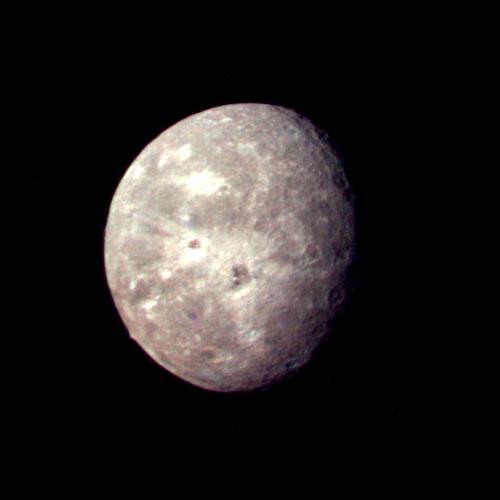
Oberon is the second largest moon of Uranus. Discovered in 1787, little was known about this moon until Voyager 2 passed it during its flyby of Uranus in January 1986. Oberon is heavily cratered―similar to Umbriel―especially when compared to three other moons of Uranus: Ariel, Titania and Miranda. Like all of Uranus' large moons, Oberon is composed of roughly half ice and half rock. Oberon has at least one large mountain that rises about 6 km off the surface.
Named by Herschel's son John in early 19th century for the king of the fairies in Shakespeare's "A Midsummer Night's Dream."