


Space › Universe › Solar System › Star › Sun › Spacecraft › Lucy
Lucy
ORBITS:
Sun
SPACECRAFT
A journey among Jupiter’s Trojan asteroids.
Discover the mission exploring asteroids that preserve clues to planetary formation, then explore its mission on the SPACE-di interactive map.
naif:
-49
Reference material: NASA · NASA / Jet Propulsion Laboratory · 3D render credits
Make Lucy part of your exploration…
Exploring the stories of Trojan asteroids…
Lucy is a man-made spacecraft represented in the Solar System, the region of space around the Sun, our star, within the universe. Its catalogue reference body is Sun. Explore its story and purpose, then find the spacecraft on the interactive 3D space map.
Lucy — Investigates main-belt asteroids and Jupiter’s Trojan populations.
Mission and scientific objectives
Lucy is associated with NASA / Southwest Research Institute. Investigates main-belt asteroids and Jupiter’s Trojan populations. The mission type is Asteroid flyby probe.
Mission chronology
2023: Dinkinesh flyby.
2025: Donaldjohanson flyby.
2027–2033: Planned Trojan encounters.
The first mission to explore the Jupiter Trojan asteroids.
Lucy will explore a record-breaking number of asteroids, flying by three asteroids in the solar system’s main asteroid belt, and by eight Trojan asteroids that share an orbit around the Sun with Jupiter.
Lucy is the first spacecraft to explore a group of asteroids known as the Jupiter Trojan asteroids.
These asteroids are remnants of our early solar system. They are trapped in stable orbits associated with – but not close to – the giant planet Jupiter.
Trojan asteroids may hold vital clues to deciphering the history of our solar system.
Planet formation and evolution models suggest that the Trojan asteroids are likely to be remnants of the same material that formed the outer planets (Jupiter, Saturn, Uranus, and Neptune), and thus serve as time capsules from the birth of our solar system over four billion years ago.
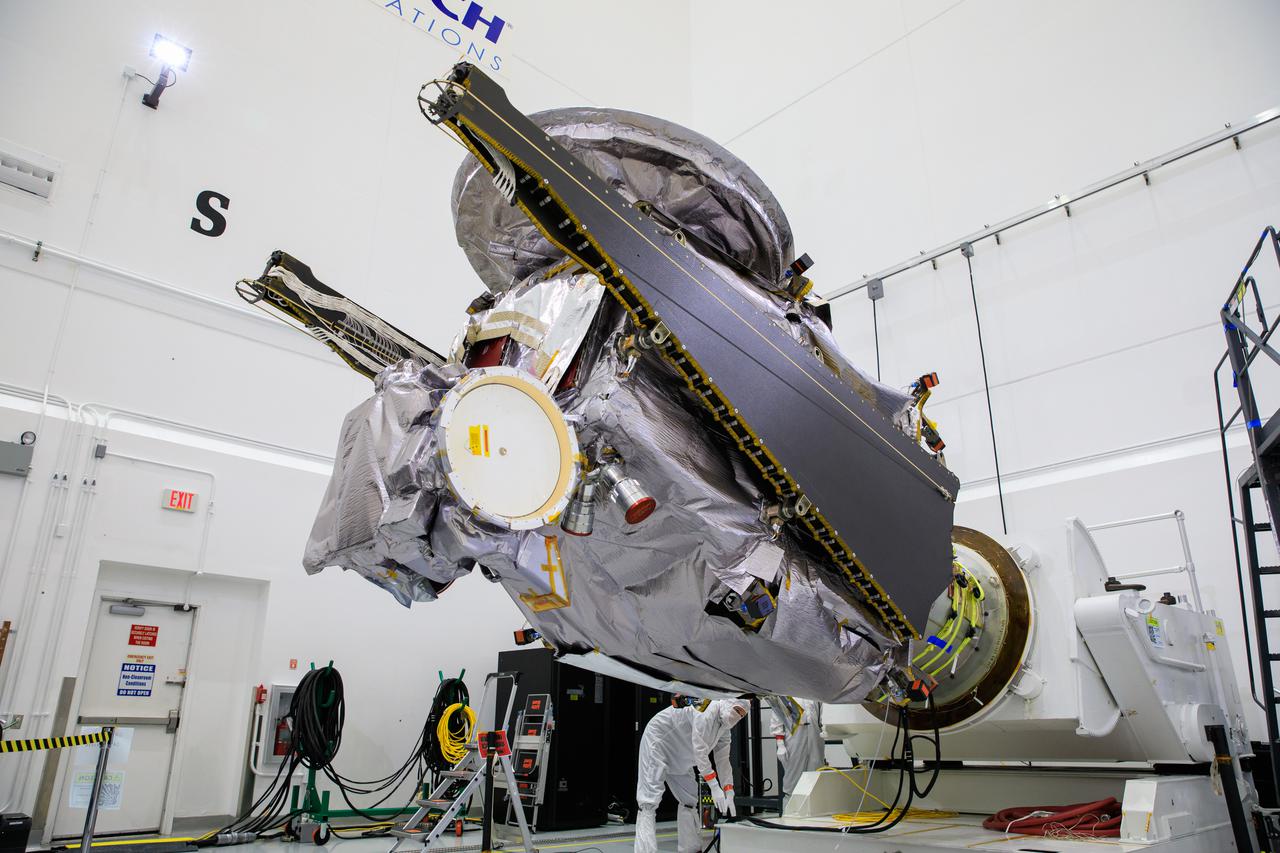
Lucy is more than 52 feet (16 meters) from tip to tip.
The spacecraft's huge solar panels are each close to 24 feet, or over 7 meters, in diameter. All of the instruments, and the 6.5 ft (2 meters) high gain antenna needed to communicate with Earth, are located on the spacecraft body.
What are the Trojan asteroids? Why go to the Trojans?
We answer your questions about the Lucy mission and the Trojan asteroids.
NASA’s Lucy Begins Camera Tests Ahead of 2027 Trojan Flybys
Preparing for the NASA Lucy spacecraft’s first Trojan asteroid encounters, mission scientists have begun instructing the spacecraft to turn its…
NASA’s Lucy Reveals Wobbling, Peanut-Shaped Asteroid
NASA’s Lucy Spacecraft Snaps Photos of Interstellar Comet 3I/ATLAS
View Interstellar Comet 3I/ATLAS Through NASA’s Multiple Lenses
Regions on Asteroid Explored by NASA’s Lucy Mission Get Official Names