top of page
space_encyclopedia_background.png

Welcome to SPACEdi's space encyclopedia profile for {objectName}. Our data engine provides object-specific articles, physical property tables, and exploration history overviews, connecting space enthusiasts, academy students, and scientific researchers to catalog imagery, structural planetary dimensions, and interactive 3D solar system models.

​

Platform Overview & Interactive Data Profiles:

​

Engineered by ARCHIMEDES Aerospace, this element bridges telemetry and ephemeris datasets with an immersive canvas interface for {Object_Name}. The interactive sandbox features:

​

  • Comprehensive Scale View: Investigate atmospheric layers, bulk composition, and surface features.

  • Voyage Planning Simulator: Deploy custom spacecraft objects to model complex orbital trajectories.

  • Integrated Scientific Engine: View related systems, natural satellites, and historical mission data from NASA, JPL, and ESA.

​

The platform supports flexible user levels—from free guest controls to saved personal libraries and academic integrations.

Juliet is a moon of Uranus, part of the Solar System in the universe. Uranus is a planet associated with the Sun, our star, and this space encyclopedia describes the moon’s identity and place in its planetary system.

Juliet — A natural satellite of Uranus. Its physical properties and orbital motion are shown from the available catalogue and ephemeris data.

No object-specific chemical/elemental dataset has been verified and imported for this record. This does not mean none is publicly available. Appearance may be imagined; chemistry is not.

Discovery and designation
Juliet was discovered in 1986. JPL credits Voyager Science Team. Its provisional designation is S/1986 U2. The name and discovery entry identify this particular satellite of Uranus; similarly named asteroids are separate objects.

Juliet was discovered on Jan. 3, 1986 in images taken by Voyager 2. It is one of the 10 Uranian satellites discovered by the Voyager science team.

Juliet is one of the small, inner moons of Uranus. Little is known about it other than its size and orbital characteristics. Neither its size nor its albedo have been measured directly, but assuming an albedo of 0.07 like Puck, its surface probably consists of the dark, unprocessed, carbon-rich material found on the C-class of asteroids.

Originally called S/1986 U2, Juliet was named for the title character in William Shakespeare's play, "Romeo and Juliet." Juliet is the daughter of the Capulets, who are sworn enemies to the Montagues. Nevertheless, she falls in love with Romeo, son of the Montagues.

space_encyclopedia_background.png

Juliet

moon · Uranus · Juliet. A 1986 discovery in Uranus’s skies.
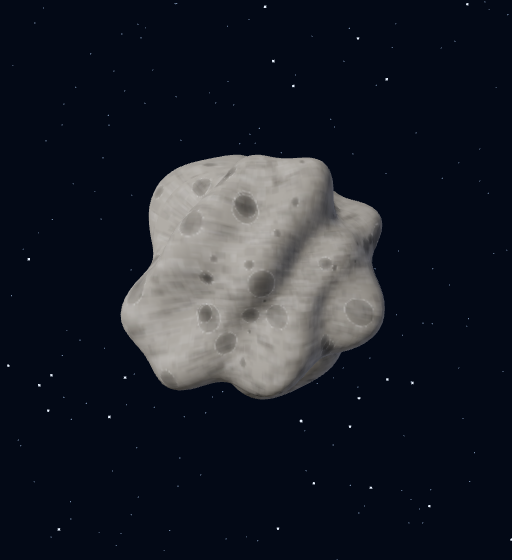
Juliet

Discover Juliet, a moon of Uranus with an orbital semi-major axis of about 64,362 km, discovered in 1986, then explore its place in the Solar System on the SPACE-di interactive map.

View Juliet in the 3D Solar System

Overview

Juliet is a moon of Uranus, part of the Solar System in the universe. Uranus is a planet associated with the Sun, our star, and this space encyclopedia describes the moon’s identity and place in its planetary system.

Juliet — A natural satellite of Uranus. Its physical properties and orbital motion are shown from the available catalogue and ephemeris data.

No object-specific chemical/elemental dataset has been verified and imported for this record. This does not mean none is publicly available. Appearance may be imagined; chemistry is not.

Discovery and designation

Juliet was discovered in 1986. JPL credits Voyager Science Team. Its provisional designation is S/1986 U2. The name and discovery entry identify this particular satellite of Uranus; similarly named asteroids are separate objects.

Juliet was discovered on Jan. 3, 1986 in images taken by Voyager 2. It is one of the 10 Uranian satellites discovered by the Voyager science team.

Juliet is one of the small, inner moons of Uranus. Little is known about it other than its size and orbital characteristics. Neither its size nor its albedo have been measured directly, but assuming an albedo of 0.07 like Puck, its surface probably consists of the dark, unprocessed, carbon-rich material found on the C-class of asteroids.

Originally called S/1986 U2, Juliet was named for the title character in William Shakespeare's play, "Romeo and Juliet." Juliet is the daughter of the Capulets, who are sworn enemies to the Montagues. Nevertheless, she falls in love with Romeo, son of the Montagues.

Key properties

Orbital period
0.4931 days
bottom of page