


Space › Universe › Solar System › Star › Sun › Spacecraft › IMAP
IMAP
ORBITS:
Sun
SPACECRAFT
Tracing the boundary of the Sun’s influence.
Discover the mission using particles and fields to investigate the heliosphere and interstellar space, then explore its mission on the SPACE-di interactive map.
naif:
-43
Reference material: NASA · NASA / Jet Propulsion Laboratory · 3D render credits
Make IMAP part of your exploration…
IMAP: a mission of discovery…
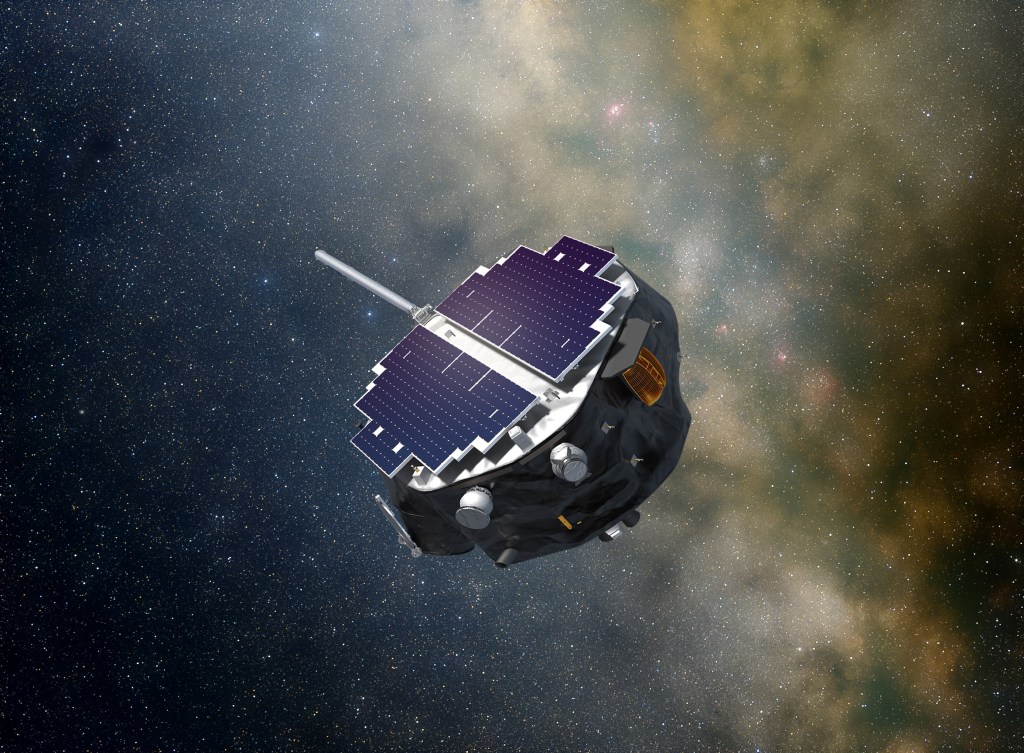
IMAP is a man-made spacecraft represented in the Solar System, the region of space around the Sun, our star, within the universe. Its catalogue reference body is Sun. Explore its story and purpose, then find the spacecraft on the interactive 3D space map.
IMAP — Measures particles, fields and dust to investigate the heliosphere and its interstellar boundary.
Mission and scientific objectives
IMAP is associated with NASA. Measures particles, fields and dust to investigate the heliosphere and its interstellar boundary. The mission type is Heliospheric observatory.
Interstellar Mapping and Acceleration Probe
IMAP helps researchers better understand the boundary of the heliosphere, a huge bubble created by the Sun surrounding and protecting our solar system.
IMAP, a Modern-day Celestial Cartographer
NASA’s Interstellar Mapping and Acceleration Probe, or IMAP, is a new mission that maps the boundaries of our heliosphere — a giant protective bubble created by the Sun that encapsulates our solar system. The spacecraft studies the Sun’s activity and how the heliosphere boundary interacts with the local galactic neighborhood beyond.Video Credit: NASA/Joy Ng
The Interstellar Mapping and Acceleration Probe, or IMAP, explores and maps the very boundaries of our heliosphere — a huge bubble created by the Sun's wind that encapsulates our entire solar system — and studies how the heliosphere interacts with the local galactic neighborhood beyond.
As a modern-day celestial cartographer, IMAP also explores and charts the vast range of particles in interplanetary space, helping to investigate two of the most important overarching issues in heliophysics — the energization of charged particles from the Sun, and the interaction of the solar wind at its boundary with interstellar space. Additionally, IMAP supports real-time observations of the solar wind and energetic particles, which can produce hazardous conditions in the space environment near Earth.
The IMAP mission uses 10 scientific instruments to chart a comprehensive picture of what’s roiling in space, from high-energy particles originating at the Sun, to magnetic fields in interplanetary space, to remnants of exploded stars in interstellar space.
The mission primarily investigates two of the most important overarching issues in heliophysics. Namely, how charged particles from the Sun are energized to form what’s known as the solar wind and how that wind interacts with interstellar space at the heliosphere’s boundary.
This boundary offers protection from the harsher radiation from the rest of the galaxy. It is key to creating and maintaining a habitable solar system. The physics of the boundary and how it changes over time helps explain why our solar system can support life as we know it.
Keeping an Eye on Space Weather
The IMAP mission additionally supports real-time observations of the solar wind, which can flood the near-Earth space environment with dangerous particles and radiation that could harm technology and astronauts in space and disrupt global communications and electrical grids on Earth. The IMAP spacecraft is situated at the first Earth-Sun Lagrange point (L1), at around one million miles from Earth toward the Sun. There, it can provide about a half hour's warning to voyaging astronauts and spacecraft near Earth of harmful radiation coming their way.
Together, these areas of research will:
IMAP is a modern-day celestial cartographer.
Like explorers and cartographers, IMAP aims to fill in blank spots on the map of the heliosphere — the bubble surrounding the Sun and planets inflated by the solar wind — and expand our knowledge of the physical processes happening in our solar system. To study the heliosphere and how it interacts with material from interstellar space, IMAP is stationed at L1. There, it collects and measures particles that have traveled from the Sun, the heliosphere’s boundary 6 to 9 billion miles away, and interstellar space. While foundational maps of the heliosphere have been drawn by IMAP’s predecessors, cutting-edge instrumentation on IMAP allows it to map it in greater detail than ever before, using tiny particles to answer big questions about the vast, invisible frontiers of our solar system. In addition to improving maps of the heliosphere’s boundary, measurements of these tiny particles enhances our understanding of the composition of other stars and better predict when dangerous space weather is imminent near Earth.
Energetic Neutral Atoms: Mapping the Boundaries of the Heliosphere
The mission’s investigation of the boundaries of the heliosphere is primarily done with energetic neutral atoms, or ENAs. An ENA is a type of uncharged particle formed when an energetic positively charged ion runs into a slow-moving neutral atom. The ion picks up an extra negatively charged electron in the collision, making it neutral — hence the name energetic neutral atom. This process frequently happens wherever there is plasma in space, such as throughout the heliosphere, including its boundary. Since they are not charged, ENAs do not interact with the magnetic fields that permeate space and shape the boundary of the heliosphere. Charged particles are forced to follow magnetic field lines, but ENAs travel in a straight line, unaffected by the twists, turns and turbulences in a magnetic field. This means scientists can track where these atomic messengers came from and study distant plasma-filled regions of space from afar. The IMAP mission uses the ENAs it collects near Earth to trace back their origins and construct cosmic maps of the boundaries of the heliosphere, which would otherwise be invisible from such a distance. This work with ENAs helps scientists understand the forces that drive changes at the interstellar boundary, such as the Sun’s relative motion through the galactic neighborhood, the pressures exerted from magnetic fields and the interstellar matter outside the heliosphere, and the ever-changing output of winds from the Sun.
Solar Wind and Energetic Particles: Advanced Warning for Space Weather
The IMAP mission provides real-time observations of the solar wind and solar energetic particles from the strategic L1 point between Earth and the Sun. This vantage point, at around one million miles from Earth in the Sun’s direction, can provide about a half hour's warning to voyaging astronauts and spacecraft near Earth of harmful radiation coming their way.The IMAP Active Link for Real-Time (I-ALiRT) system uses a portion of data from IMAP’s instruments to provide enhanced space weather information. This system frequently broadcasts reliable data for space weather models, allowing for much better predictions and warnings of increases in damaging particles from the Sun.
Cosmic Dust: Understanding Celestial Building Blocks
In addition to measuring tiny individual particles, IMAP makes direct measurements of cosmic dust — conglomerations of particles originating outside of the solar system that are smaller than a grain of sand. While the dust you encounter indoors is made up of mostly organic materials, this space dust is largely composed of rocky or carbon-rich grains. The specific composition of this space dust — how much of each element it contains — is a postmark for where it comes from in the galaxy. Studying cosmic dust can provide insight into the compositions of stars from far outside our solar system. It also helps scientists significantly advance what we know about these basic cosmic building materials and provide information on what the material between stars is made of.
Animations, videos, images, and more related to IMAP are available on NASA's Scientific Visualization Studio.
Animations of the IMAP spacecraft are available on NASA's Scientific Visualization Studio.
IMAP Testing & Integration Images
Images and videos of testing performed on the IMAP spacecraft at NASA’s Marshall Space Flight Center.
NASA’s IMAP Mission Releases New Data From 7 Science Instruments
NASA’s IMAP Begins Primary Science Mission
NASA’s IMAP Mission Reaches Its Destination
NASA’s IMAP Mission Captures ‘First Light,’ Looks Back at Earth
La NASA y la NOAA lanzan tres naves espaciales para cartografiar la…
Webb is the premier observatory of the next decade, serving thousands of astronomers worldwide. It studies every phase in the…
This rover and its aerial sidekick were assigned to study the geology of Mars and seek signs of ancient microbial…
On a mission to “touch the Sun,” NASA's Parker Solar Probe became the first spacecraft to fly through the corona…
NASA’s Juno spacecraft entered orbit around Jupiter in 2016, the first explorer to peer below the planet's dense clouds to…