top of page
space_encyclopedia_background.png

Welcome to SPACEdi's space encyclopedia profile for {objectName}. Our data engine provides object-specific articles, physical property tables, and exploration history overviews, connecting space enthusiasts, academy students, and scientific researchers to catalog imagery, structural planetary dimensions, and interactive 3D solar system models.

​

Platform Overview & Interactive Data Profiles:

​

Engineered by ARCHIMEDES Aerospace, this element bridges telemetry and ephemeris datasets with an immersive canvas interface for {Object_Name}. The interactive sandbox features:

​

  • Comprehensive Scale View: Investigate atmospheric layers, bulk composition, and surface features.

  • Voyage Planning Simulator: Deploy custom spacecraft objects to model complex orbital trajectories.

  • Integrated Scientific Engine: View related systems, natural satellites, and historical mission data from NASA, JPL, and ESA.

​

The platform supports flexible user levels—from free guest controls to saved personal libraries and academic integrations.

Hyperion is a moon of Saturn, part of the Solar System in the universe. Saturn is a planet associated with the Sun, our star, and this space encyclopedia describes the moon’s identity and place in its planetary system.

Hyperion — A natural satellite of Saturn. Its physical properties and orbital motion are shown from the available catalogue and ephemeris data.

No object-specific chemical/elemental dataset has been verified and imported for this record. This does not mean none is publicly available. Appearance may be imagined; chemistry is not.

Discovery and designation
Hyperion was discovered in 1848. JPL credits W.C Bond, G.P. Bond, W. Lassell. The name and discovery entry identify this particular satellite of Saturn; similarly named asteroids are separate objects.

William Lassell discovered Hyperion in 1848. That same year William Cranch Bond, with his son George Phillips Bond, independently discovered the moon. All three men are jointly credited with the discovery.

Hyperion is the largest of Saturn's irregular, nonspherical moons. Hyperion's mean radius is 83.9 miles (135 kilometers), but since Hyperion is rather potato-shaped, its shape can be described in terms of its diameter along its three axes: 255 x 163 x 137 miles (410 x 260 x 220 kilometers, respectively). Considering its odd shape, Hyperion is probably a remnant of a larger moon that was destroyed by a major impact.

Hyperion's density is slightly more than half that of water. This could be due to water ice with gaps (porosity) of more than 40 percent. Also, lighter materials, such as frozen methane or carbon dioxide, could make up part of Hyperion. This is consistent with the concept of Hyperion accreting from a number of smaller ice and rock bodies, but not having enough gravity to compact them. Thus, Hyperion might be similar to a large rubble pile.

Hyperion rotates chaotically, tumbling unpredictably through space as it orbits Saturn. Hyperion orbits at a mean distance of 933,000 miles (1,500,000 kilometers) from Saturn in an eccentric orbit. This contributes to variations in the spin or rotation of Hyperion. A stronger effect on Hyperion's rotation is that it is in resonance with Saturn's largest moon, Titan, which orbits at 759,200 miles (1,221,850 kilometers). Thus, the two objects speed up and slow down as they pass each other in a complex set of variations. Because Hyperion is much smaller than Titan, its rotation and orbit are affected vastly more than the larger moon, and Titan apparently keeps the Hyperion orbit eccentric rather than growing more circular over time.

The great distance from Saturn and resonance with Titan has also kept Hyperion from becoming tidally locked facing Saturn. Hyperion rotates roughly every 13 days during its 21-day orbit.

The most noticeable close-up feature of Hyperion is its deeply cratered surface. Hyperion and its sister outer moons, Phoebe and Iapetus, all show extensive cratering because they are Saturn's most distant moons and have experienced very little tidal warming that might blur or erase earlier features. However, the Hyperion craters are particularly deep and do not have significant rays of ejecta (although there appears to have been slumping or landslides inside many of the bigger craters). The result is a curiously punched-in look, somewhat like the surface of a sponge or a wasp nest. Planetary geologists have theorized that Hyperion's high-porosity and low density would crater more by compression than excavation.

Many of the crater walls on Hyperion are bright, which suggests an abundance of water ice. The crater floors are mostly the areas of the lowest albedo (a measure of how reflective the surface is) and greatest red coloration. This may be because the average temperature of roughly -300 degrees Fahrenheit (-180 degrees Celsius) might be close enough to a temperature that would cause volatiles to sublimate, leaving the darker materials accumulated on the crater floors. This scenario fits with some of the newer crater floors being bright water ice.

John Herschel suggested that the moons of Saturn be associated with the mythical brothers and sisters of Kronus. (Kronus is the equivalent of the Roman god Saturn in Greek mythology.)

The name Hyperion comes from the Greek god (or Titan) Hyperion (he who watches over). Hyperion, the son of Uranus and Gaia, is a brother of Kronus and the husband of Thea. The children of Hyperion and Thea include Helios (the sun), Eos (the dawn) and Selene (the Moon).

space_encyclopedia_background.png

Hyperion

moon · Saturn · An irregular moon with a tumbling spin.
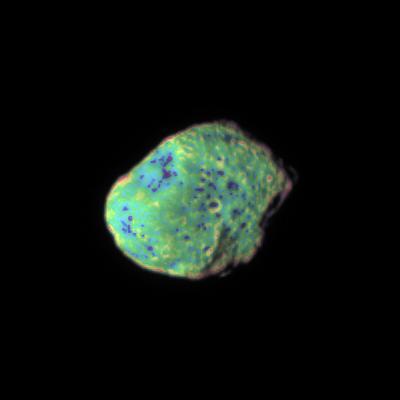
Multicolor Hyperion

Discover the porous-looking Saturnian moon known for its chaotic rotation, then explore its place in the Solar System on the SPACE-di interactive map.

View Hyperion in the 3D Solar System

Overview

Hyperion is a moon of Saturn, part of the Solar System in the universe. Saturn is a planet associated with the Sun, our star, and this space encyclopedia describes the moon’s identity and place in its planetary system.

Hyperion — A natural satellite of Saturn. Its physical properties and orbital motion are shown from the available catalogue and ephemeris data.

No object-specific chemical/elemental dataset has been verified and imported for this record. This does not mean none is publicly available. Appearance may be imagined; chemistry is not.

Discovery and designation

Hyperion was discovered in 1848. JPL credits W.C Bond, G.P. Bond, W. Lassell. The name and discovery entry identify this particular satellite of Saturn; similarly named asteroids are separate objects.

William Lassell discovered Hyperion in 1848. That same year William Cranch Bond, with his son George Phillips Bond, independently discovered the moon. All three men are jointly credited with the discovery.

Hyperion is the largest of Saturn's irregular, nonspherical moons. Hyperion's mean radius is 83.9 miles (135 kilometers), but since Hyperion is rather potato-shaped, its shape can be described in terms of its diameter along its three axes: 255 x 163 x 137 miles (410 x 260 x 220 kilometers, respectively). Considering its odd shape, Hyperion is probably a remnant of a larger moon that was destroyed by a major impact.

Hyperion's density is slightly more than half that of water. This could be due to water ice with gaps (porosity) of more than 40 percent. Also, lighter materials, such as frozen methane or carbon dioxide, could make up part of Hyperion. This is consistent with the concept of Hyperion accreting from a number of smaller ice and rock bodies, but not having enough gravity to compact them. Thus, Hyperion might be similar to a large rubble pile.

Hyperion rotates chaotically, tumbling unpredictably through space as it orbits Saturn. Hyperion orbits at a mean distance of 933,000 miles (1,500,000 kilometers) from Saturn in an eccentric orbit. This contributes to variations in the spin or rotation of Hyperion. A stronger effect on Hyperion's rotation is that it is in resonance with Saturn's largest moon, Titan, which orbits at 759,200 miles (1,221,850 kilometers). Thus, the two objects speed up and slow down as they pass each other in a complex set of variations. Because Hyperion is much smaller than Titan, its rotation and orbit are affected vastly more than the larger moon, and Titan apparently keeps the Hyperion orbit eccentric rather than growing more circular over time.

The great distance from Saturn and resonance with Titan has also kept Hyperion from becoming tidally locked facing Saturn. Hyperion rotates roughly every 13 days during its 21-day orbit.

The most noticeable close-up feature of Hyperion is its deeply cratered surface. Hyperion and its sister outer moons, Phoebe and Iapetus, all show extensive cratering because they are Saturn's most distant moons and have experienced very little tidal warming that might blur or erase earlier features. However, the Hyperion craters are particularly deep and do not have significant rays of ejecta (although there appears to have been slumping or landslides inside many of the bigger craters). The result is a curiously punched-in look, somewhat like the surface of a sponge or a wasp nest. Planetary geologists have theorized that Hyperion's high-porosity and low density would crater more by compression than excavation.

Many of the crater walls on Hyperion are bright, which suggests an abundance of water ice. The crater floors are mostly the areas of the lowest albedo (a measure of how reflective the surface is) and greatest red coloration. This may be because the average temperature of roughly -300 degrees Fahrenheit (-180 degrees Celsius) might be close enough to a temperature that would cause volatiles to sublimate, leaving the darker materials accumulated on the crater floors. This scenario fits with some of the newer crater floors being bright water ice.

John Herschel suggested that the moons of Saturn be associated with the mythical brothers and sisters of Kronus. (Kronus is the equivalent of the Roman god Saturn in Greek mythology.)

The name Hyperion comes from the Greek god (or Titan) Hyperion (he who watches over). Hyperion, the son of Uranus and Gaia, is a brother of Kronus and the husband of Thea. The children of Hyperion and Thea include Helios (the sun), Eos (the dawn) and Selene (the Moon).

Key properties

Mean radius
135 km
Orbital period
21.276658 days

Exploration history

Cassini’s September 2005 close flyby revealed Hyperion’s deeply cratered, sponge-like terrain. False-colour processing helps distinguish variations in its surface materials.

bottom of page