


Space › Universe › Solar System › Star › Sun › Planet › Saturn › Moon › Helene
Helene
ORBITS:
Saturn
MOON
Helene. A 1980 discovery in Saturn’s skies.
Discover Helene, a moon of Saturn with an orbital semi-major axis of about 377,600 km, discovered in 1980, then explore its place in the Solar System on the SPACE-di interactive map.
naif:
612
Reference material: NASA / Jet Propulsion Laboratory · NASA · 3D render credits
Make Helene part of your exploration…
Helene: a companion of Saturn…
Helene is a moon of Saturn, part of the Solar System in the universe. Saturn is a planet associated with the Sun, our star, and this space encyclopedia describes the moon’s identity and place in its planetary system.
Helene — A natural satellite of Saturn. Its physical properties and orbital motion are shown from the available catalogue and ephemeris data.
No object-specific chemical/elemental dataset has been verified and imported for this record. This does not mean none is publicly available. Appearance may be imagined; chemistry is not.
Discovery and designation
Helene was discovered in 1980. JPL credits P. Laques and J. Lecacheux. Its provisional designation is S/1980 S6. The name and discovery entry identify this particular satellite of Saturn; similarly named asteroids are separate objects.
Helene was discovered on March 1, 1980 during the Earth ring-plane crossing by J. Lecacheux and others.
Helene, a small and faint moon of Saturn, is referred to as a Trojan moon because it shares its orbit with another moon—Dione, a moon hundreds of times larger than Helene. This complex orbital arrangement is held steady by gravity: Helene is located at a Lagrange point, where it feels the tug of gravity equally from distant Saturn and nearby Dione. For this reason, soon after it was discovered in 1980 it was called Dione B.
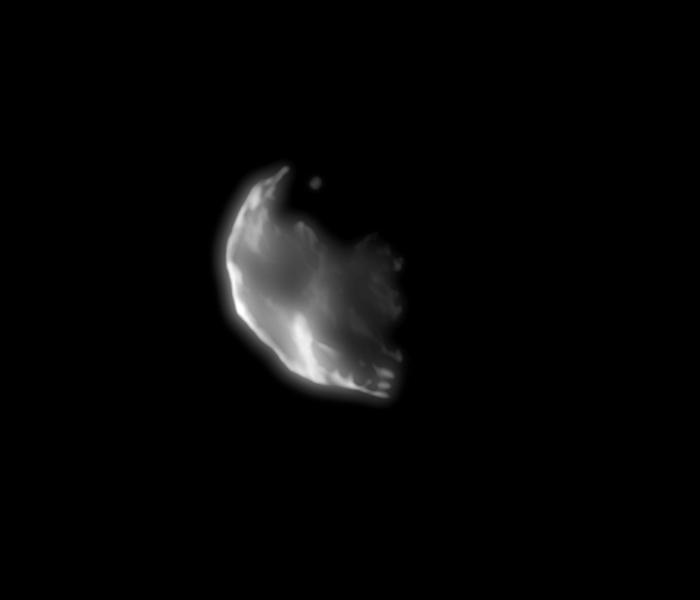
This irregularly shaped moon has a mean radius of 10.9 miles (17.6 kilometers) with dimensions 22 x 19 x 18.6 miles (36 x 32 x 30 km). It orbits 234,505 miles (377,400 kilometers) away from Saturn, taking 2.7 Earth days to complete one orbit.
John Herschel suggested that the moons of Saturn be associated with mythical brothers and sisters of Kronus. (Kronus is the equivalent of the Roman god Saturn in Greek mythology.) The International Astronomical Union now controls the official naming of astronomical bodies.
Originally designated S/1980 S6, Helene is named after the granddaughter of Kronus and is the sister of Polydeuces. Helene was born out of an egg since Zeus took the shape of a swan when he raped her mother Leda. The account of this engendering is retold in the poem "Leda and the Swan" by William Butler Yeats. This same figure in Greek mythology was the cause of the Trojan War.