


Space › Universe › Solar System › Star › Sun › Planet › Jupiter › Moon › Ganymede
Ganymede
ORBITS:
Jupiter
MOON
The largest moon has a magnetic story.
Discover the Solar System’s largest moon, with its own intrinsic magnetic field, then explore its place in the Solar System on the SPACE-di interactive map.
naif:
503
Reference material: NASA / Jet Propulsion Laboratory · NASA · 3D render credits
Make Ganymede part of your exploration…
Ganymede: a companion of Jupiter…
Ganymede is a moon of Jupiter, part of the Solar System in the universe. Jupiter is a planet associated with the Sun, our star, and this space encyclopedia describes the moon’s identity and place in its planetary system.
Ganymede is the largest moon in the Solar System and the only moon known to generate its own intrinsic magnetic field. Evidence for a deep salty ocean makes it a major target for modern planetary research.
Surface mixtures of rock and water ice. Inferred iron core and rocky shell beneath an icy shell, with evidence of a subsurface saltwater ocean and tenuous oxygen atmosphere.
Discovery and designation
Ganymede was discovered in 1610. JPL credits Galileo. The name and discovery entry identify this particular satellite of Jupiter; similarly named asteroids are separate objects.
The largest moon in the solar system, this icy world is the only moon to have its own magnetic field – and the atmospheric auroras that come with that.
Jupiter’s icy moon Ganymede is the largest moon in our solar system, even bigger than the planet Mercury, and the dwarf planet Pluto. There’s strong evidence that Ganymede has an underground saltwater ocean that may hold more water than all the water on Earth's surface. It might even have ice and oceans stacked up in several layers like a club sandwich.
Ganymede is the only moon known to have its own magnetic field – something typically found on planets like Earth. The magnetic field causes auroras, or bright ribbons of glowing gas, that circle the moon’s poles.
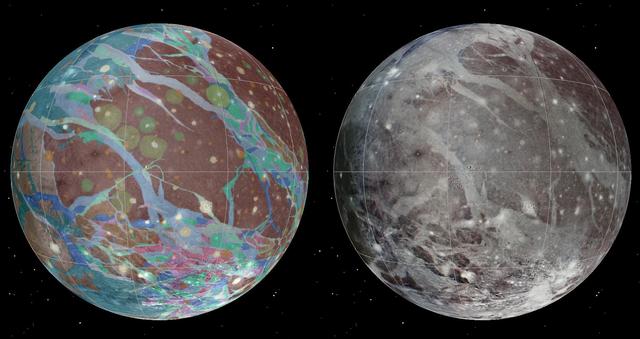
Ganymede, As Seen by Pioneer 10 and Galileo
Several NASA probes have explored Jupiter and its moons, including Ganymede. The Juno spacecraft was most recent, taking detailed photographs of Ganymede in June 2021.
Images taken by Juno on June 7, 2021, provided a fresh look at features on Ganymede’s surface including craters, clearly distinct dark, and bright terrain, and long structural features possibly linked to tectonic faults. Deep inside Ganymede, there’s a metallic iron core that generates the moon's magnetic field. A shell of rock surrounds the core, and another icy shell surrounds the rock.
There is evidence Ganymede has a tenuous oxygen atmosphere.
What Webb Is Teaching Us About Our Solar System
Ganymede Grooved Terrain as Seen by Juno’s JIRAM
Salts and Organics Observed on Ganymede’s Surface by NASA’s Juno
Ocean Worlds: Water in the Solar System and Beyond
Icy Moonquakes: Surface Shaking Could Trigger Landslides