top of page
space_encyclopedia_background.png

Welcome to SPACEdi's space encyclopedia profile for {objectName}. Our data engine provides object-specific articles, physical property tables, and exploration history overviews, connecting space enthusiasts, academy students, and scientific researchers to catalog imagery, structural planetary dimensions, and interactive 3D solar system models.

​

Platform Overview & Interactive Data Profiles:

​

Engineered by ARCHIMEDES Aerospace, this element bridges telemetry and ephemeris datasets with an immersive canvas interface for {Object_Name}. The interactive sandbox features:

​

  • Comprehensive Scale View: Investigate atmospheric layers, bulk composition, and surface features.

  • Voyage Planning Simulator: Deploy custom spacecraft objects to model complex orbital trajectories.

  • Integrated Scientific Engine: View related systems, natural satellites, and historical mission data from NASA, JPL, and ESA.

​

The platform supports flexible user levels—from free guest controls to saved personal libraries and academic integrations.

space_encyclopedia_background.png

Dysnomia

moon · Eris · Dysnomia. A close companion in Eris’s system.
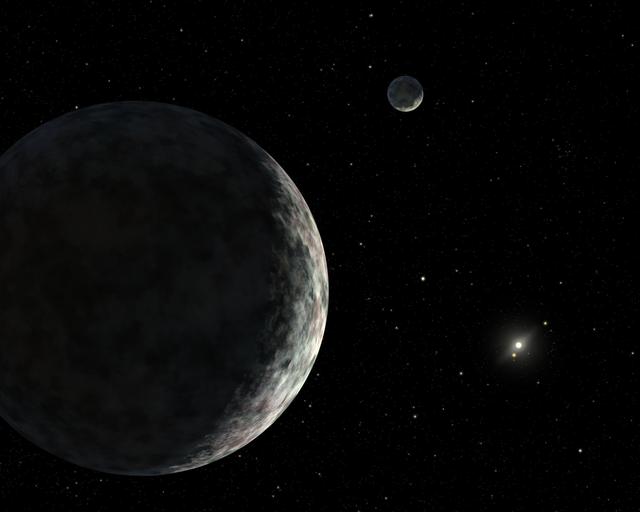
Eris and Dysnomia Artist Concept

Discover Dysnomia, a moon of Eris with an orbital semi-major axis of about 37,273 km, then explore its place in the Solar System on the SPACE-di interactive map.

View Dysnomia in the 3D Solar System

Overview

Dysnomia is a moon of Eris, part of the Solar System in the universe. Eris is a dwarf planet associated with the Sun, our star, and this space encyclopedia describes the moon’s identity and place in its planetary system.

Dysnomia — A natural satellite of Eris. Its physical properties and orbital motion are shown from the available catalogue and ephemeris data.

No object-specific chemical/elemental dataset has been verified and imported for this record. This does not mean none is publicly available. Appearance may be imagined; chemistry is not.

bottom of page