

Despina
moon · Neptune · Despina. A 1989 discovery in Neptune’s skies.
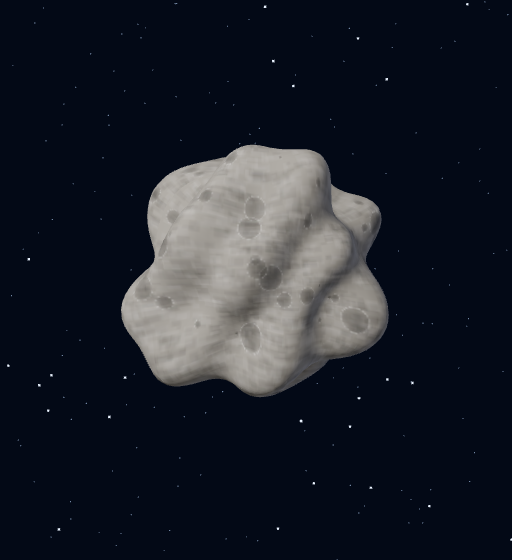
Discover Despina, a moon of Neptune with an orbital semi-major axis of about 52,500 km, discovered in 1989, then explore its place in the Solar System on the SPACE-di interactive map.
View Despina in the 3D Solar System
Overview
Despina is a moon of Neptune, part of the Solar System in the universe. Neptune is a planet associated with the Sun, our star, and this space encyclopedia describes the moon’s identity and place in its planetary system.
Despina — A natural satellite of Neptune. Its physical properties and orbital motion are shown from the available catalogue and ephemeris data.
No object-specific chemical/elemental dataset has been verified and imported for this record. This does not mean none is publicly available. Appearance may be imagined; chemistry is not.
Discovery and designation
Despina was discovered in 1989. JPL credits Voyager Science Team. Its provisional designation is S/1989 N3. The name and discovery entry identify this particular satellite of Neptune; similarly named asteroids are separate objects.
Despina was discovered in July 1989 by the Voyager 2 science team.
Despina is a tiny moon located within Neptune's faint ring system. The irregularly-shaped moon orbits Neptune every eight hours, circling in the same direction as Neptune's own rotation. Despina remains close to Neptune's equatorial plane.
Despina is a daughter of Poseidon (the Roman god Neptune) and Demeter. Despina was originally designated S/1989 N3.
Key properties
- Mean radius
- 74 km
- Orbital period
- 0.334656 days