


Space › Universe › Solar System › Star › Sun › Planet › Earth › Spacecraft › Chandra X-ray Observatory
Chandra X-ray Observatory
ORBITS:
Earth
SPACECRAFT
Revealing the Universe in X-rays.
Discover the observatory built to investigate hot gas and other high-energy cosmic sources, then explore its mission on the SPACE-di interactive map.
naif:
-151
Reference material: NASA · NASA / Jet Propulsion Laboratory · 3D render credits
Make Chandra X-ray Observatory part of your exploration…
Chandra X-ray Observatory: a mission of discovery…
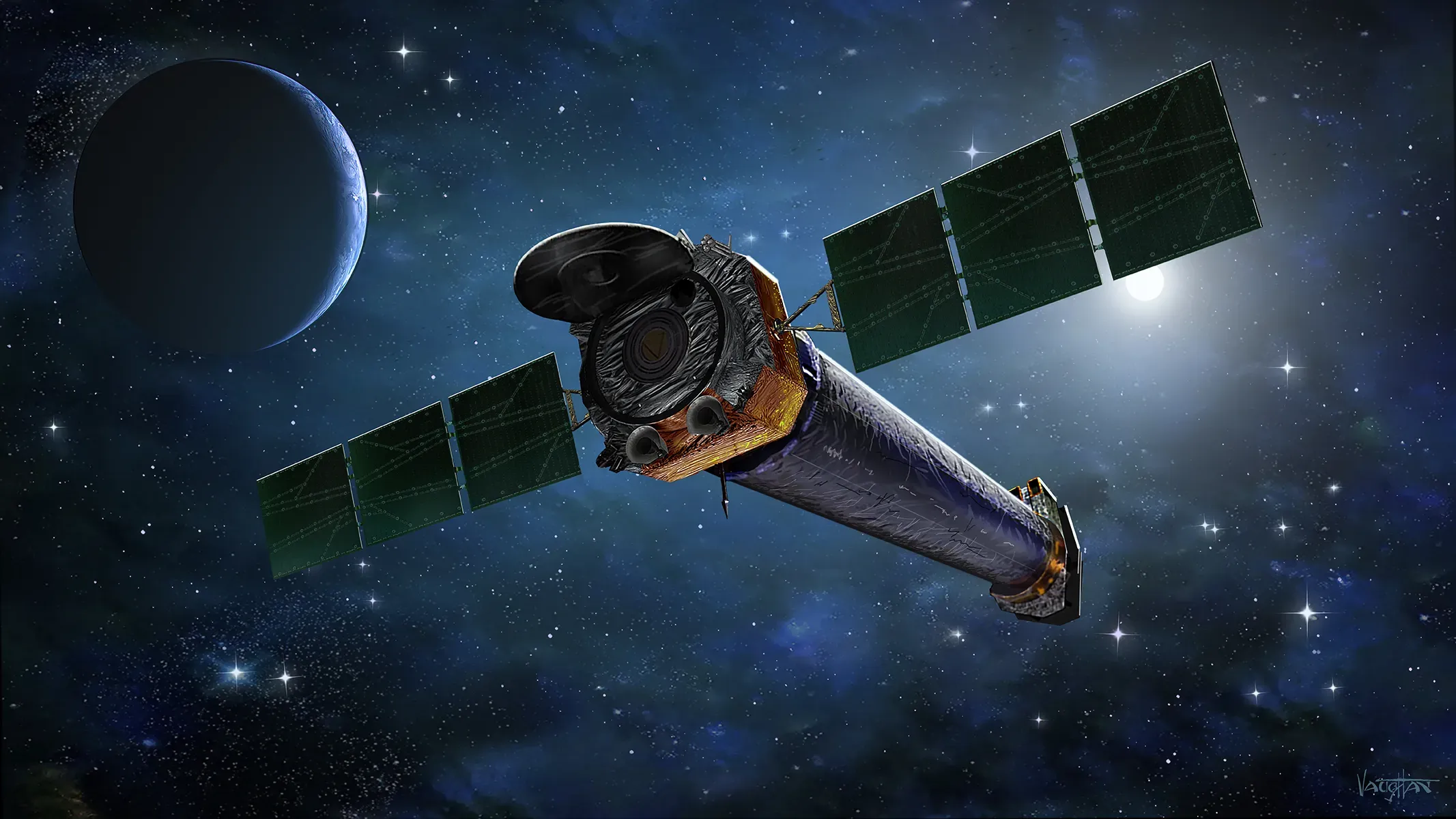
Chandra X-ray Observatory is a man-made spacecraft represented in the Solar System, the region of space around the Sun, our star, within the universe. Its catalogue reference body is Earth. Explore its story and purpose, then find the spacecraft on the interactive 3D space map.
Chandra X-ray Observatory — Studies high-energy astronomical sources from Earth orbit.
Mission and scientific objectives
Chandra X-ray Observatory is associated with NASA. Studies high-energy astronomical sources from Earth orbit. The mission type is X-ray space telescope.
The Chandra X-ray Observatory is the world's most powerful X-ray telescope. It has eight-times greater resolution and is able to detect sources more than 20-times fainter than any previous X-ray telescope.
The Chandra X-ray Observatory is part of NASA's fleet of "Great Observatories" which also includes the Hubble Space Telescope, and James Webb Space Telescope. Chandra allows scientists from around the world to obtain X-ray images of exotic environments to help understand the structure and evolution of the universe.
NASA’s Chandra Unveils Mysterious X-Ray Objects
Galactic Gems Glisten in New Gallery From NASA’s Chandra
NASA Telescopes Create Colorful ‘Craft’ From Nearby Nebula
NASA Space Telescope Maps Magnetic Fields of ‘Lighthouse’ Pulsar
NASA’s Chandra Examines Milky Way at Arms’ Length
Young ‘Sun’ Caught Blowing Bubbles by NASA’s Chandra
For the first time, a much younger version of the Sun has been caught red-handed blowing bubbles in the galaxy,…
The Chandra X-ray Observatory allows scientists from around the world to obtain X-ray images of exotic environments to help understand the structure and evolution of the universe.
The Chandra X-ray Observatory is part of NASA's fleet of "Great Observatories" which also includes the Hubble Space Telescope, and James Webb Space Telescope. Chandra allows scientists from around the world to obtain X-ray images of exotic environments to help understand the structure and evolution of the universe. The Chandra X-ray Observatory program is managed by NASA's Marshall Center for the Science Mission Directorate, NASA Headquarters, Washington, D.C. The Smithsonian Astrophysical Observatory (SAO) in Cambridge, Mass., is responsible for the conduct of the day-to-day flight operations and science activities from the Operations Control Center and Chandra X-ray Center (CXC) facilities. The CXC Web site is the primary resource for information on the Chanda X-ray Observatory mission.
Chandra Spacecraft and Instruments
The Chandra telescope system consists of four pairs of mirrors and their support structure. X-ray telescopes must be very different from optical telescopes. Because of their high-energy, X-ray photons penetrate into a mirror much as bullets slam into a wall.
Imagine making the surface of the Earth so smooth that the highest mountain was less than two meters (78 inches) tall! On a much smaller scale, the scientists and engineers at Raytheon Optical Systems in Danbury, Connecticut accomplished an equivalent feat when they polished and ground the four pairs of Chandra mirrors to the smoothness of a few atoms. Just as bullets ricochet when they hit a wall at a grazing angle, so too will X-rays ricochet off mirrors. The mirrors have to be exquisitely shaped and aligned nearly parallel to incoming X-rays. Thus they look more like glass barrels than the familiar dish shape of optical telescopes.
The Smithsonian Astrophysical Observatory (SAO) in Cambridge, Mass., is responsible for the conduct of the day-to-day flight operations and science activities from the Operations Control Center and Chandra X-ray Center (CXC) facilities.
Webb is the premier observatory of the next decade, serving thousands of astronomers worldwide. It studies every phase in the…
This rover and its aerial sidekick were assigned to study the geology of Mars and seek signs of ancient microbial…
On a mission to “touch the Sun,” NASA's Parker Solar Probe became the first spacecraft to fly through the corona…
NASA’s Juno spacecraft entered orbit around Jupiter in 2016, the first explorer to peer below the planet's dense clouds to…