top of page
space_encyclopedia_background.png

Welcome to SPACEdi's space encyclopedia profile for {objectName}. Our data engine provides object-specific articles, physical property tables, and exploration history overviews, connecting space enthusiasts, academy students, and scientific researchers to catalog imagery, structural planetary dimensions, and interactive 3D solar system models.

​

Platform Overview & Interactive Data Profiles:

​

Engineered by ARCHIMEDES Aerospace, this element bridges telemetry and ephemeris datasets with an immersive canvas interface for {Object_Name}. The interactive sandbox features:

​

  • Comprehensive Scale View: Investigate atmospheric layers, bulk composition, and surface features.

  • Voyage Planning Simulator: Deploy custom spacecraft objects to model complex orbital trajectories.

  • Integrated Scientific Engine: View related systems, natural satellites, and historical mission data from NASA, JPL, and ESA.

​

The platform supports flexible user levels—from free guest controls to saved personal libraries and academic integrations.

Ceres is a dwarf planet in the Solar System, our region of space within the universe. The Sun is the star at the centre of this system. Explore its story and place in our planetary neighbourhood, then find it on the interactive 3D space map.

Ceres is the largest object in the main asteroid belt and the only dwarf planet in the inner Solar System. NASA’s Dawn mission revealed bright salt deposits and evidence of a water-rich interior.

Rocky, dusty crust with salt deposits; water ice and a water-rich interior are inferred. A tenuous water-vapour component has been detected. Bulk water fraction is uncertain.

Dwarf planet Ceres is the largest object in the asteroid belt between Mars and Jupiter. It was explored by NASA's Dawn spacecraft.

Ceres is the only dwarf planet in the inner solar system.

Ceres was the first member of the asteroid belt to be discovered when Giuseppe Piazzi spotted it in 1801. Called an asteroid for many years, Ceres is so much bigger and so different from its rocky neighbors that scientists classified it as a dwarf planet in 2006. When NASA's Dawn arrived in 2015, Ceres became the first dwarf planet to receive a visit from a spacecraft.

Ceres was the first dwarf planet to be orbited by a spacecraft.

NASA's Dawn spacecraft reached Ceres in 2015 to study its surface, composition, and history. This was three years after Dawn had orbited the asteroid Vesta, the second-largest body in the asteroid belt, behind Ceres.

Pluto and Dwarf Planet Resources

A curated collection of resources about dwarf planets, including activities that can be done at home, as well as videos and animations, images, printable graphics, and 3D models.

Eyes on the Solar System: Ceres

After Latest Swing Past Sun, NASA’s Parker Solar Probe Checks in

NASA, IBM Launch AI Foundation Model for Lunar Science

NASA’s Hubble, Webb Find Far-out Solar System Objects ‘Remember’ Past

NASA’s Dragonfly Gets Wired Up While Titan Landing Area Is Named

The mission explored dwarf planet Ceres, and giant asteroid Vesta

A curated collection of resources, including activities that can be done at home, as well as videos and animations, images, printable graphics, and 3D models.

space_encyclopedia_background.png

Ceres

dwarf planet · Sun · A small world with a salty story.
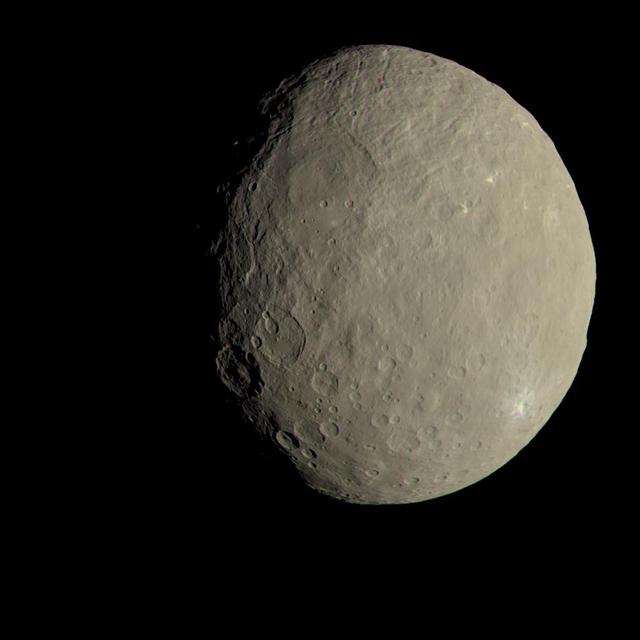
Ceres in Color

Discover the dwarf planet whose bright salt deposits hint at a water-rich interior, then explore its place in the Solar System on the SPACE-di interactive map.

View Ceres in the 3D Solar System

Overview

Ceres is a dwarf planet in the Solar System, our region of space within the universe. The Sun is the star at the centre of this system. Explore its story and place in our planetary neighbourhood, then find it on the interactive 3D space map.

Ceres is the largest object in the main asteroid belt and the only dwarf planet in the inner Solar System. NASA’s Dawn mission revealed bright salt deposits and evidence of a water-rich interior.

Rocky, dusty crust with salt deposits; water ice and a water-rich interior are inferred. A tenuous water-vapour component has been detected. Bulk water fraction is uncertain.

Dwarf planet Ceres is the largest object in the asteroid belt between Mars and Jupiter. It was explored by NASA's Dawn spacecraft.

Ceres is the only dwarf planet in the inner solar system.

Ceres was the first member of the asteroid belt to be discovered when Giuseppe Piazzi spotted it in 1801. Called an asteroid for many years, Ceres is so much bigger and so different from its rocky neighbors that scientists classified it as a dwarf planet in 2006. When NASA's Dawn arrived in 2015, Ceres became the first dwarf planet to receive a visit from a spacecraft.

Ceres was the first dwarf planet to be orbited by a spacecraft.

NASA's Dawn spacecraft reached Ceres in 2015 to study its surface, composition, and history. This was three years after Dawn had orbited the asteroid Vesta, the second-largest body in the asteroid belt, behind Ceres.

Pluto and Dwarf Planet Resources

A curated collection of resources about dwarf planets, including activities that can be done at home, as well as videos and animations, images, printable graphics, and 3D models.

Eyes on the Solar System: Ceres

After Latest Swing Past Sun, NASA’s Parker Solar Probe Checks in

NASA, IBM Launch AI Foundation Model for Lunar Science

NASA’s Hubble, Webb Find Far-out Solar System Objects ‘Remember’ Past

NASA’s Dragonfly Gets Wired Up While Titan Landing Area Is Named

The mission explored dwarf planet Ceres, and giant asteroid Vesta

A curated collection of resources, including activities that can be done at home, as well as videos and animations, images, printable graphics, and 3D models.

Key properties

Mean radius
469.7 km

Exploration history

Dawn explored Ceres from orbit, allowing scientists to study the dwarf planet’s surface and its conspicuous bright deposits.

bottom of page