


Space › Universe › Solar System › Star › Sun › Planet › Saturn › Moon › Atlas
Atlas
ORBITS:
Saturn
MOON
A moon shaped like no ordinary sphere.
Discover Saturn’s small moon with its distinctive equatorial ridge, then explore its place in the Solar System on the SPACE-di interactive map.
naif:
615
Reference material: NASA / Jet Propulsion Laboratory · NASA · 3D render credits
Make Atlas part of your exploration…
Atlas: a companion of Saturn…
Atlas is a moon of Saturn, part of the Solar System in the universe. Saturn is a planet associated with the Sun, our star, and this space encyclopedia describes the moon’s identity and place in its planetary system.
Atlas — A natural satellite of Saturn. Its physical properties and orbital motion are shown from the available catalogue and ephemeris data.
No object-specific chemical/elemental dataset has been verified and imported for this record. This does not mean none is publicly available. Appearance may be imagined; chemistry is not.
Discovery and designation
Atlas was discovered in 1980. JPL credits Voyager Science Team. Its provisional designation is S/1980 S28. The name and discovery entry identify this particular satellite of Saturn; similarly named asteroids are separate objects.
Atlas was discovered in 1980 by R. Terrile and the Voyager 1 team from photographs taken during its encounter with Saturn.
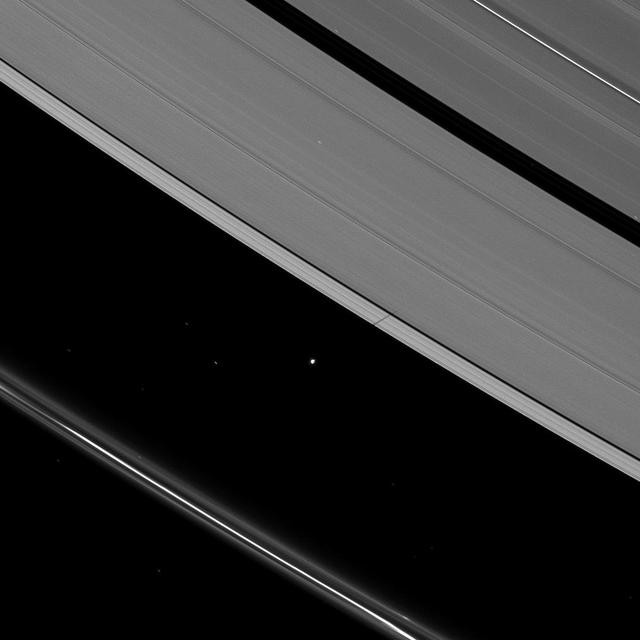
Atlas is an inner moon of Saturn, orbiting around the outer edge of Saturn's A Ring. Like Pan, Atlas has a distinctive flying saucer shape created by a prominent equatorial ridge not seen on the other small moons of Saturn. Cassini images revealed in 2004 that a temporary faint ring of material with the orbit of Atlas.
The small, pointy moon has a mean radius of 9.4 miles (15.1 km). It orbits 85,544 miles (137,670 km) away from, taking 14.4 hours to complete its trip around the planet.
Moons of Saturn were originally named for Greco-Roman Titans and descendants of the Titans. But as many new moons were discovered, scientists began selecting names from more mythologies including Gallic, Inuit, and Norse stories.
Originally designated S/1980 S28, this moon is named after Atlas, a Titan, and a son of Iapetus. Atlas was ordered by Zeus to uphold the vault of the sky after the defeat of the Titans. Atlas was so strong that he supported the weight of the Universe on his shoulders.