top of page
space_encyclopedia_background.png

Welcome to SPACEdi's space encyclopedia profile for {objectName}. Our data engine provides object-specific articles, physical property tables, and exploration history overviews, connecting space enthusiasts, academy students, and scientific researchers to catalog imagery, structural planetary dimensions, and interactive 3D solar system models.

​

Platform Overview & Interactive Data Profiles:

​

Engineered by ARCHIMEDES Aerospace, this element bridges telemetry and ephemeris datasets with an immersive canvas interface for {Object_Name}. The interactive sandbox features:

​

  • Comprehensive Scale View: Investigate atmospheric layers, bulk composition, and surface features.

  • Voyage Planning Simulator: Deploy custom spacecraft objects to model complex orbital trajectories.

  • Integrated Scientific Engine: View related systems, natural satellites, and historical mission data from NASA, JPL, and ESA.

​

The platform supports flexible user levels—from free guest controls to saved personal libraries and academic integrations.

space_encyclopedia_background.png

Asteroid belt

belt region · Sun · A realm of small worlds between Mars and Jupiter.
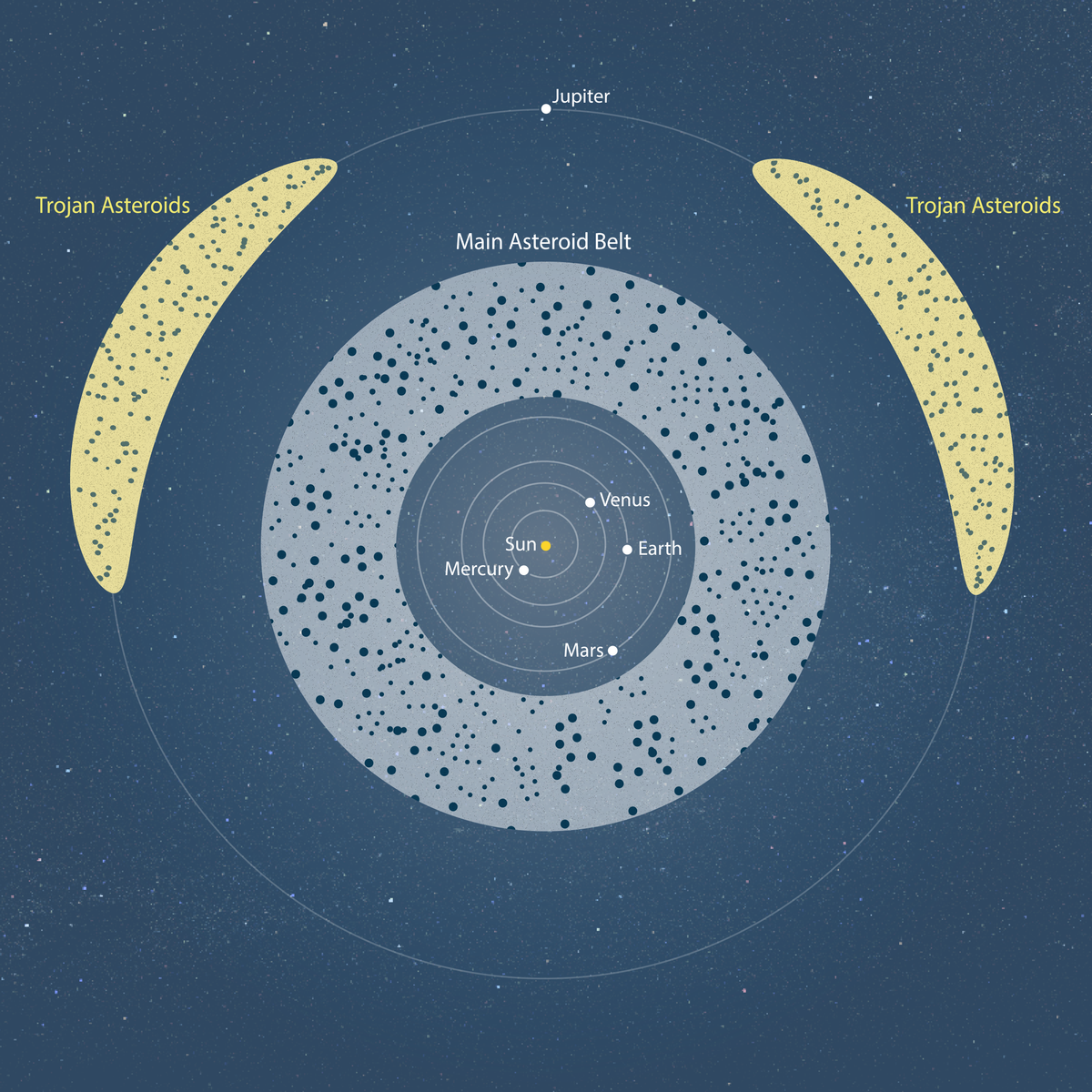
Main asteroid belt and Jupiter’s Trojan groups

Discover the broad population of asteroids orbiting between Mars and Jupiter, then explore its place on the map on the SPACE-di interactive map.

View Asteroid belt in the 3D Solar System

Overview

Asteroid belt is a belt region in the Solar System, our region of space within the universe. The Sun is the star at the centre of this system. Explore its story and place in our planetary neighbourhood, then find it on the interactive 3D space map.

Asteroid belt — An illustrative guide to the main asteroid belt, roughly 2.1–3.3 astronomical units from the Sun. Its dots are not individual catalogued asteroids. Objects include carbon-rich, silicate-rich and metal-rich bodies; each has its own orbit and composition. There is no single belt rotation speed.

bottom of page