


Space › Universe › Solar System › Star › Sun › Planet › Earth › Moon › Moon › Spacecraft › ARTEMIS P2
ARTEMIS P2
ORBITS:
Moon
SPACECRAFT
A second viewpoint on the Moon’s plasma environment.
Discover ARTEMIS P2 and its complementary measurements alongside the P1 probe, then explore its mission on the SPACE-di interactive map.
naif:
-193
Reference material: NASA · NASA / Jet Propulsion Laboratory · 3D render credits
Make ARTEMIS P2 part of your exploration…
ARTEMIS P2: a mission of discovery…
ARTEMIS P2 is a man-made spacecraft represented in the Solar System, the region of space around the Sun, our star, within the universe. Its catalogue reference body is Moon. Explore its story and purpose, then find the spacecraft on the interactive 3D space map.
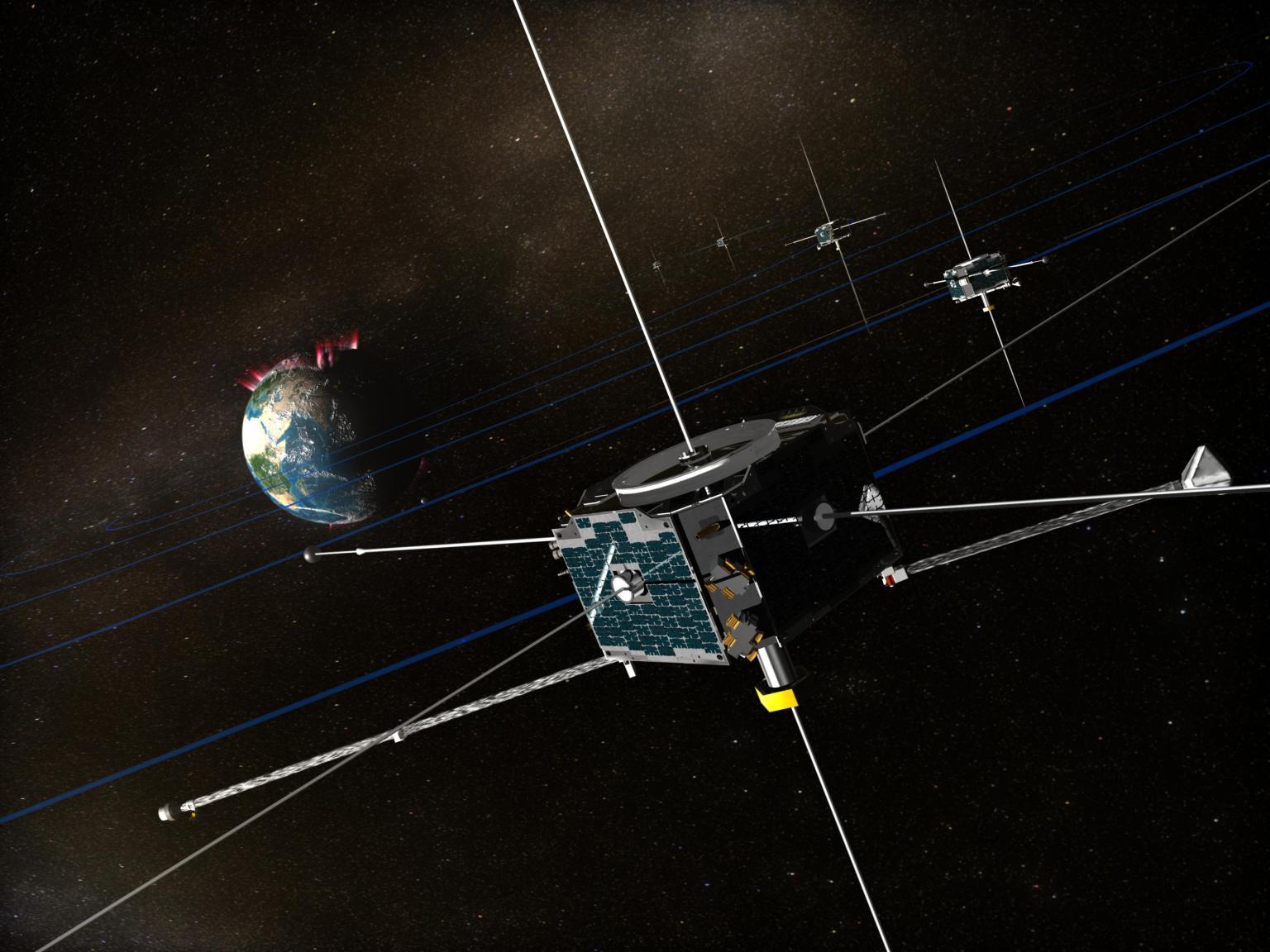
ARTEMIS P2 — A repurposed THEMIS probe studying the Moon’s plasma environment.
Mission and scientific objectives
ARTEMIS P2 is associated with NASA / University of California, Berkeley. A repurposed THEMIS probe studying the Moon’s plasma environment. The mission type is Lunar orbiter.
Mission chronology
Originally launched with THEMIS
later redirected to lunar orbit.
Time History of Events and Macroscale Interactions during Substorms (THEMIS) - Acceleration, Reconnection, Turbulence and Electrodynamics of Moon's Interaction with the Sun (ARTEMIS)
Launched in 2007, THEMIS studies how mass and energy move through the near-Earth space environment to determine the physical processes initiating auroras. In 2010, two of its five spacecraft were repurposed as ARTEMIS and moved to a new location to study similar processes closer to the Moon.
Note: This page refers to the twin robotic spacecraft currently studying the Moon. For details on NASA's Artemis campaign to return astronauts to the lunar surface, visit: www.nasa.gov/artemis
NASA's THEMIS-ARTEMIS mission is made up of two probes: P1 and P2. They were originally part of the successful THEMIS (Time History of Events and Macroscale Interactions during Substorms) mission that orbited Earth and studied the aurora. NASA redirected the two probes to the Moon, where they became the ARTEMIS (Acceleration, Reconnection, Turbulence and Electrodynamics of the Moon's Interaction with the Sun) mission.
Jan. 1, 2009: THEMIS-P1 and P2 are reassigned, renamed, and redirected to the Moon
Aug. 25, 2010: ARTEMIS-P1 arrives at the L2 Lagrange point
Oct. 22, 2010: ARTEMIS-P2 arrives at the L1 Lagrange point
The two ARTEMIS lunar orbit missions were repurposed from the original Time History of Events and Macroscale Interactions during Substorms (THEMIS) mission that involved five NASA satellites: THEMIS A, B, C, D and E. The satellites were originally launched to study a type of magnetic phenomena called substorms in Earth’s magnetosphere that tend to intensify auroras near Earth’s poles.
Each of the five satellites carried identical instrumentation. After a burn of the third stage, the five THEMIS spacecraft—initially joined but soon separated—were deposited into a 290 x 54,270 mile (469 × 87,337-kilometer) orbit around Earth at 16 degrees.
In a “string-of-pearls” configuration, the five satellites carried out their initial mission without any significant anomalies.
On May 19, 2008, Space Sciences Laboratories, developer of the spacecraft at University of California–Berkeley, announced that NASA had extended the THEMIS mission to 2012 and that two of the THEMIS satellites, B and C, would be sent into lunar orbit as part of a new mission under the name ARTEMIS (Acceleration, Reconnection, Turbulence and Electrodynamics of the Moon’s Interaction with the Sun).
In this new mission, THEMIS B and C were renamed ARTEMIS-P1 and ARTEMIS-P2, respectively, and redirected to study the Earth-Moon Lagrange points, the solar wind, the Moon’s plasma wake, and the interaction between Earth’s magnetotail and the Moon’s own weak magnetism.
The “P1” and “P2” designations were from the THEMIS mission, which used “P1” and “P2” to denote the operational orbits of THEMIS B and C.
On the 40th anniversary of the Apollo 11 landing, July 20, 2009, ARTEMIS-P1 and P2 officially began low thrust maneuvers that, over the following year and a half, led them to the L2 and L1 Lagrange points, opposite the near and far sides of the Moon, respectively. This phase included a lunar flyby on March 28, 2010, by ARTEMIS-P2.
On Aug. 25, 2010, an engine burn propelled ARTEMIS-P1 into orbit around the Earth-Moon L2 Lagrange point, located on the far side of the Moon, about 38,000 miles (61,300 kilometers) above the lunar surface. This was the first time that a spacecraft had successfully entered orbit around an Earth-Moon libration point.
The second spacecraft, ARTEMIS-P2, arrived at L1 on Oct. 22, 2010, by which time P1 had completed about four revolutions around L2.
The station-keeping at the Lagrange points on the way to the Moon was designed to avoid Earth’s long shadows and to keep the spacecraft operational. Once at the two Lagrange points, both spacecraft collected magnetospheric data from opposite sides of the Moon, critical for simultaneous measurements of particles and electric and magnetic fields to build a three-dimensional map of the acceleration of energetic particles near the Moon’s orbit.
On June 27, 2011, ARTEMIS-P1 successfully entered lunar orbit with an initial orbit of roughly 2,200 × 17,000 miles (3,543 × 27,000 kilometers) while its sister vehicle, ARTEMIS-P2, entered lunar orbit on July 17, 2011, after a two-year journey from Earth orbit.
Over the next three months, mission controllers implemented a series of maneuvers to move the second spacecraft into an orbit with a period of 27.5 hours, similar to its companion but moving in the opposite direction.
The two spacecraft, orbiting in opposite directions around the Moon, began to provide the first 3D measurements of the Moon’s magnetic field to determine its regional influence on solar wind particles. More specifically, they revealed new information on the lunar “wake” that extends about 12 lunar radii and in particular how its void distorts the interplanetary magnetic field causing it to bulge moonward.
Mission scientists marked the 10th anniversary of the launch in February 2017 and both spacecraft continue to operate in good health.
National Space Science Data Center Master Catalog: THEMIS-B (ARTEMIS-P1)
National Space Science Data Center Master Catalog: THEMIS-C (ARTEMIS-P2)
Out of THEMIS, ARTEMIS: Earth's loss is Moon's gain
Two NASA Spacecraft Begin New Exploration Assignments
Siddiqi, Asif A. Beyond Earth: A Chronicle of Deep Space Exploration, 1958-2016. NASA History Program Office, 2018.
What NASA Is Learning from the Biggest Geomagnetic Storm in 20 Years
Lunar Gateway Instruments to Improve Weather Forecasting for Artemis Astronauts
NASA Spacecraft Helps Identify Solar Radiation Patterns That Expose the Moon
Artemis, meet ARTEMIS: Pursuing Sun Science at the Moon
NASA Mission Reveals Origins of Moon’s ‘Sunburn’
Webb is the premier observatory of the next decade, serving thousands of astronomers worldwide. It studies every phase in the…
This rover and its aerial sidekick were assigned to study the geology of Mars and seek signs of ancient microbial…
On a mission to “touch the Sun,” NASA's Parker Solar Probe became the first spacecraft to fly through the corona…
NASA’s Juno spacecraft entered orbit around Jupiter in 2016, the first explorer to peer below the planet's dense clouds to…