top of page
space_encyclopedia_background.png

Welcome to SPACEdi's space encyclopedia profile for {objectName}. Our data engine provides object-specific articles, physical property tables, and exploration history overviews, connecting space enthusiasts, academy students, and scientific researchers to catalog imagery, structural planetary dimensions, and interactive 3D solar system models.

​

Platform Overview & Interactive Data Profiles:

​

Engineered by ARCHIMEDES Aerospace, this element bridges telemetry and ephemeris datasets with an immersive canvas interface for {Object_Name}. The interactive sandbox features:

​

  • Comprehensive Scale View: Investigate atmospheric layers, bulk composition, and surface features.

  • Voyage Planning Simulator: Deploy custom spacecraft objects to model complex orbital trajectories.

  • Integrated Scientific Engine: View related systems, natural satellites, and historical mission data from NASA, JPL, and ESA.

​

The platform supports flexible user levels—from free guest controls to saved personal libraries and academic integrations.

Anthe is a moon of Saturn, part of the Solar System in the universe. Saturn is a planet associated with the Sun, our star, and this space encyclopedia describes the moon’s identity and place in its planetary system.

Anthe — A natural satellite of Saturn. Its physical properties and orbital motion are shown from the available catalogue and ephemeris data.

No object-specific chemical/elemental dataset has been verified and imported for this record. This does not mean none is publicly available. Appearance may be imagined; chemistry is not.

Discovery and designation
Anthe was discovered in 2007. JPL credits Cassini Imaging Science Team. Its provisional designation is S/2007 S4. The name and discovery entry identify this particular satellite of Saturn; similarly named asteroids are separate objects.

The Cassini Imaging team discovered Anthe on May 30, 2007, although a check back revealed Anthe in Cassini images as early as June 2004. Anthe is the 60th confirmed moon of Saturn.

Anthe is a tiny moon with a mean radius of 0.6 miles (0.9 kilometers) that orbits between Mimas and Enceladus about 122,800 miles (197,700 kilometers) from Saturn. Anthe and two other tiny moons, Methone and Pallene, may have split from either Mimas or Enceladus, or all five moons may be the remains of a larger swarm that traveled in that area close to Saturn. Anthe circles Saturn in approximately 25 hours.

Because these three tiny moons orbit at very similar distances from Saturn, they are in a dynamical relationship. Mimas strongly perturbs the tiny moons Methone, Pallene, and Anthe, all of which orbit between Mimas and the next major moon, Enceladus. The vastly more massive Mimas has the greatest effect on Anthe, causing the Methone orbit to vary by as much as 12.4 miles (20 kilometers), and has a slightly smaller effect on Pallene.

Together, these three moons may also be contributing particles to Saturn's E ring. Material blasted off Anthe by micrometeoroid impacts is believed to the source of the Anthe Ring Arc, a faint partial ring arout Saturn that is co-orbital with the moon first detected in June 2007.

As a consequence of its small size and recent discovery, astronomers have few details on the characteristics of Anthe and its neighbors Methone and Pallene, such as reflectivity (called albedo), rotation (probably tidally locked on Saturn because they are so close), and composition.

John Herschel suggested that the moons of Saturn be associated with the mythical brothers and sisters of Kronus. (In Greek mythology, Kronus is the equivalent of the Roman god Saturn.) The International Astronomical Union now controls the official naming of astronomical bodies.

The name Anthe comes from the name in Greek mythology of one of seven Alkyonides—daughters of the god (or Titan) Alkyoneus. Alkyoneus sprang from Gaea and the blood of Uranus. This blood was spilled when Uranus' son—and Alkyoneus' brother—Kronus castrated his father. Herakles (Hercules) killed Alkyoneus in the war between the gods of Mount Olympus and the Titans. Overcome by grief, the daughters threw themselves into the sea to die, but the goddess Amphitrite took pity on them and transformed them into halcyons or kingfishers.

Astronomers also refer to Anthe as Saturn XLIX, and before it was confirmed, it was known as S/2007 S4.

space_encyclopedia_background.png

Anthe

moon · Saturn · Anthe. A 2007 discovery in Saturn’s skies.
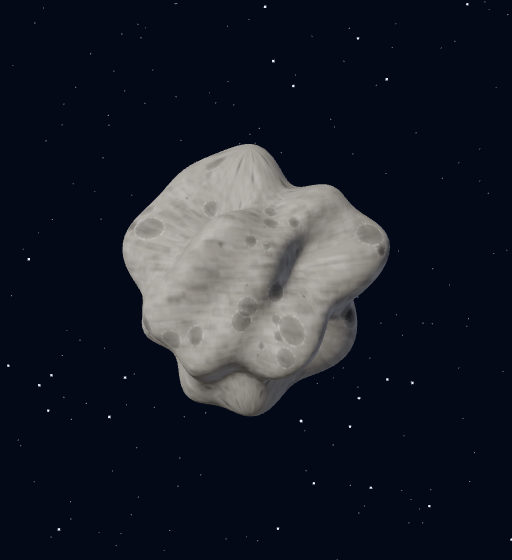
Anthe

Discover Anthe, a moon of Saturn with an orbital semi-major axis of about 198,100 km, discovered in 2007, then explore its place in the Solar System on the SPACE-di interactive map.

View Anthe in the 3D Solar System

Overview

Anthe is a moon of Saturn, part of the Solar System in the universe. Saturn is a planet associated with the Sun, our star, and this space encyclopedia describes the moon’s identity and place in its planetary system.

Anthe — A natural satellite of Saturn. Its physical properties and orbital motion are shown from the available catalogue and ephemeris data.

No object-specific chemical/elemental dataset has been verified and imported for this record. This does not mean none is publicly available. Appearance may be imagined; chemistry is not.

Discovery and designation

Anthe was discovered in 2007. JPL credits Cassini Imaging Science Team. Its provisional designation is S/2007 S4. The name and discovery entry identify this particular satellite of Saturn; similarly named asteroids are separate objects.

The Cassini Imaging team discovered Anthe on May 30, 2007, although a check back revealed Anthe in Cassini images as early as June 2004. Anthe is the 60th confirmed moon of Saturn.

Anthe is a tiny moon with a mean radius of 0.6 miles (0.9 kilometers) that orbits between Mimas and Enceladus about 122,800 miles (197,700 kilometers) from Saturn. Anthe and two other tiny moons, Methone and Pallene, may have split from either Mimas or Enceladus, or all five moons may be the remains of a larger swarm that traveled in that area close to Saturn. Anthe circles Saturn in approximately 25 hours.

Because these three tiny moons orbit at very similar distances from Saturn, they are in a dynamical relationship. Mimas strongly perturbs the tiny moons Methone, Pallene, and Anthe, all of which orbit between Mimas and the next major moon, Enceladus. The vastly more massive Mimas has the greatest effect on Anthe, causing the Methone orbit to vary by as much as 12.4 miles (20 kilometers), and has a slightly smaller effect on Pallene.

Together, these three moons may also be contributing particles to Saturn's E ring. Material blasted off Anthe by micrometeoroid impacts is believed to the source of the Anthe Ring Arc, a faint partial ring arout Saturn that is co-orbital with the moon first detected in June 2007.

As a consequence of its small size and recent discovery, astronomers have few details on the characteristics of Anthe and its neighbors Methone and Pallene, such as reflectivity (called albedo), rotation (probably tidally locked on Saturn because they are so close), and composition.

John Herschel suggested that the moons of Saturn be associated with the mythical brothers and sisters of Kronus. (In Greek mythology, Kronus is the equivalent of the Roman god Saturn.) The International Astronomical Union now controls the official naming of astronomical bodies.

The name Anthe comes from the name in Greek mythology of one of seven Alkyonides—daughters of the god (or Titan) Alkyoneus. Alkyoneus sprang from Gaea and the blood of Uranus. This blood was spilled when Uranus' son—and Alkyoneus' brother—Kronus castrated his father. Herakles (Hercules) killed Alkyoneus in the war between the gods of Mount Olympus and the Titans. Overcome by grief, the daughters threw themselves into the sea to die, but the goddess Amphitrite took pity on them and transformed them into halcyons or kingfishers.

Astronomers also refer to Anthe as Saturn XLIX, and before it was confirmed, it was known as S/2007 S4.

Key properties

Orbital period
1.038898 days
bottom of page