


Space › Universe › Solar System › Star › Sun › Planet › Saturn › Moon › Aegaeon
Aegaeon
ORBITS:
Saturn
MOON
Aegaeon. A 2008 discovery in Saturn’s skies.
Discover Aegaeon, a moon of Saturn with an orbital semi-major axis of about 167,500 km, discovered in 2008, then explore its place in the Solar System on the SPACE-di interactive map.
naif:
653
Reference material: NASA / Jet Propulsion Laboratory · NASA · 3D render credits
Make Aegaeon part of your exploration…
Aegaeon: a companion of Saturn…
Aegaeon is a moon of Saturn, part of the Solar System in the universe. Saturn is a planet associated with the Sun, our star, and this space encyclopedia describes the moon’s identity and place in its planetary system.
Aegaeon — A natural satellite of Saturn. Its physical properties and orbital motion are shown from the available catalogue and ephemeris data.
No object-specific chemical/elemental dataset has been verified and imported for this record. This does not mean none is publicly available. Appearance may be imagined; chemistry is not.
Discovery and designation
Aegaeon was discovered in 2008. JPL credits Cassini Imaging Science Team. Its provisional designation is S/2008 S1. The name and discovery entry identify this particular satellite of Saturn; similarly named asteroids are separate objects.
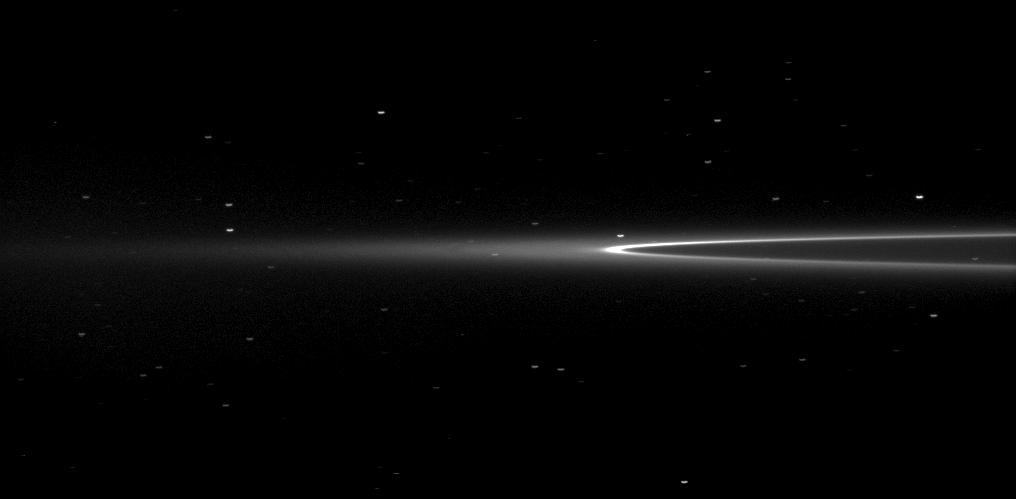
Scientists imaged the moonlet on Aug. 15, 2008, and then confirmed its presence by finding it in two earlier images. The moonlet is too small to be resolved by Cassini's cameras, so its size cannot be measured directly. However, Cassini scientists estimated the moonlet's size by comparing its brightness to another small Saturnian moon, Pallene.
Hedman and his collaborators also have found that the moonlet's orbit is being disturbed by the larger, nearby moon Mimas, which is responsible for keeping the ring arc together.
Aegaeon is the smallest known moon of Saturn. It's not quite spherical, but is instead roughly football-shaped. The tiny moonlet has a mean radius of 0.2 miles (0.12 km) and orbits Saturn at an average distance of 104,080 miles (167,500 km) in 0.808 Earth days, at an inclination of 0.001 degrees to Saturn's equator, with an eccentricity of nearly zero—meaning it's almost perfectly circular. At this distance from Saturn, Aegaeon is embedded within a partial ring, or ring arc, previously found by Cassini, the G ring. Debris knocked off the moon forms a bright arc near the inner edge, which in turn spreads to form the rest of the ring.
Saturn's rings were named in the order they were discovered. Working outward they are D, C, B, A, F, G, E and a very distant disk or ring encompassing the orbit of the moon Phoebe. The G ring is one of the outer diffuse rings. Within the faint G ring there is a relatively bright and narrow, 150-miles (250-km-wide) arc of ring material, which extends 90,000 miles (150,000 km), or one-sixth of the way around the ring's circumference.
Based on its interaction with the dust particles that make up the G ring arc Aegaeon is embedded in, this small moon most likely has a density around half that of water ice. But unlike ice, Aegaeon is very dark. It's the least reflective of any Saturnian moon inward of Titan.
Originally designated S/2008 S1, Aegaeon is named for a fierce giant with many heads and arms who helped conquer the Titans.